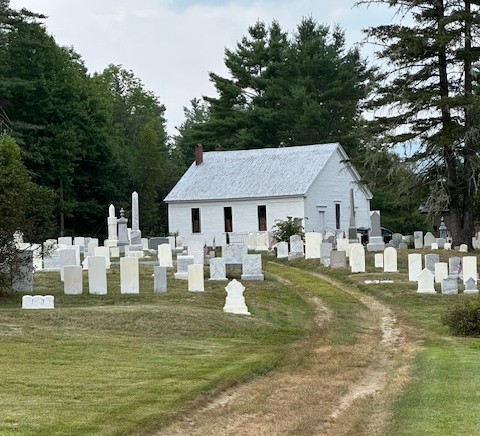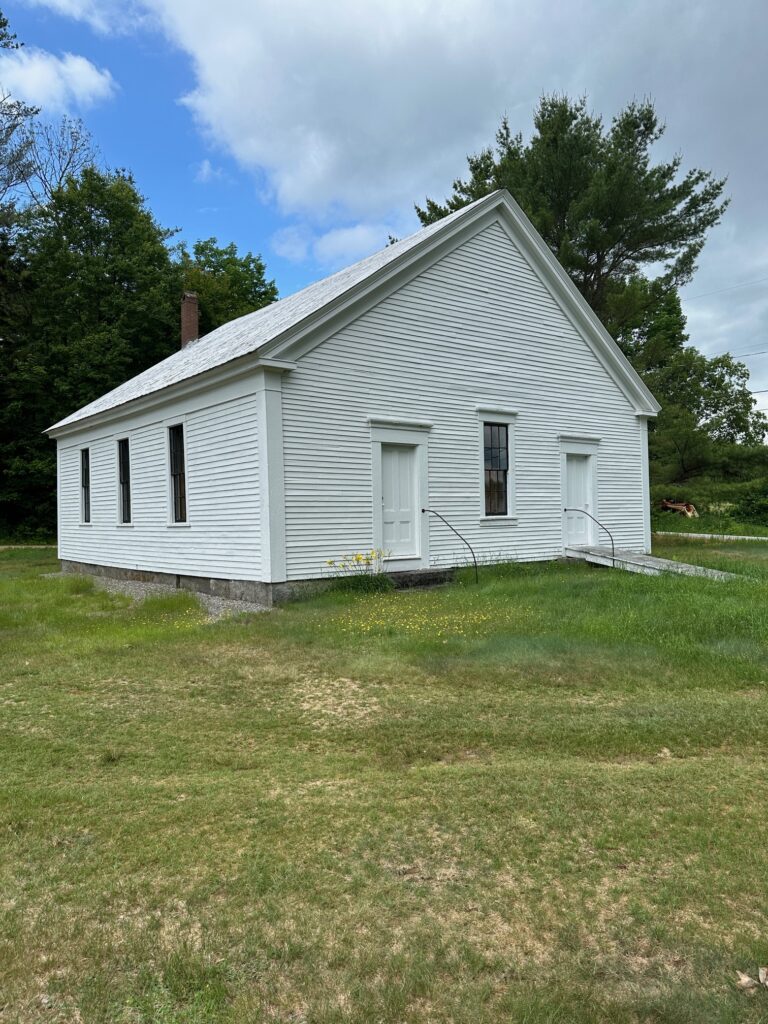
The Hastings Homestead Museum is honored to announce that it has accepted title to the Lower Meetinghouse (“East Bethel Church”), constructed circa 1831. The Hastings family has a strong connection to the structure, John Decatur Hastings (born at the Homestead in 1825) having married a Kimball and settled on a nearby farm still owned by his descendants. The Meetinghouse and adjoining East Bethel Cemetery were added to the National Register of Historic Places in 2013. Here is the official description of significance provided by the Maine Historic Preservation Commission:
“Lower Meetinghouse and East Bethel Cemetery, Bethel, circa 1817, 1831, 1887, 1901
National Register of Historic Places
Date listed: 6/25/2013
Criterion C: Architecture Criterion Consideration A: Religious Properties. Local significance
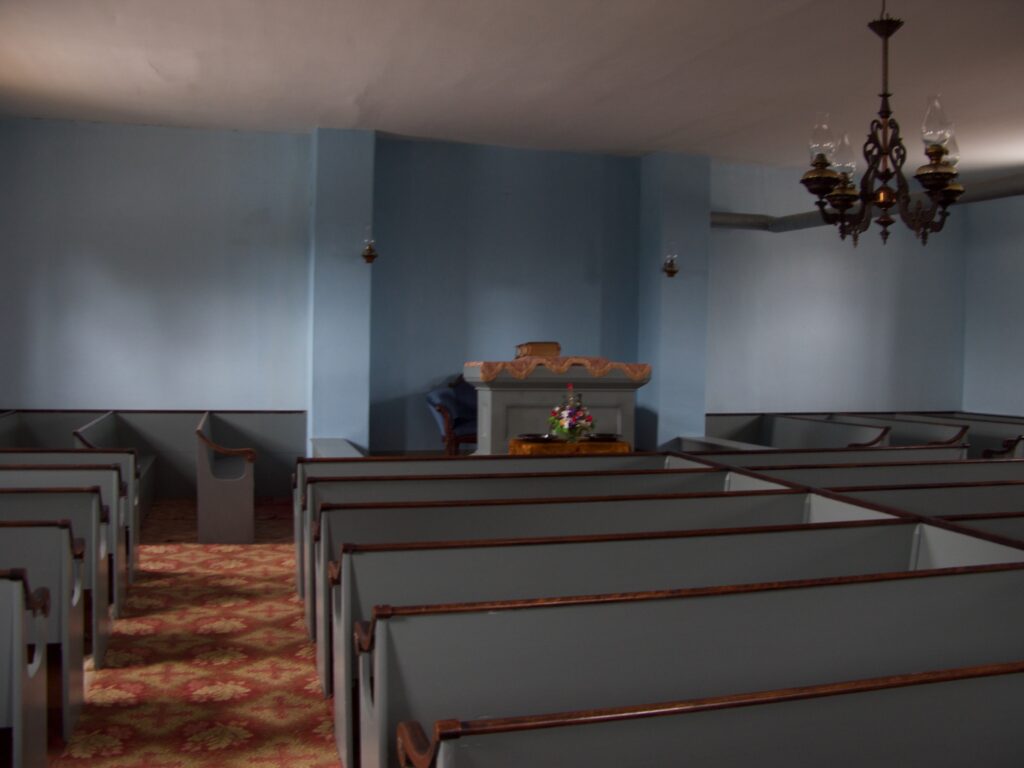
Located in the rural settlement of East Bethel, Maine (also known as Bean’s Corner), the Lower Meetinghouse is a classic example of a type of meeting house or church that was erected by some rural communities in Maine in the four decades prior to the Civil War. Built as a “union” church, the building was initially utilized by the town’s Methodist and Baptist church organizations. The relatively plain building exhibits late Federal style massing and ornamentation, and a handsome interior with straight wooden pews, wainscoting, choir loft and pulpit. Erected by 1831, and somewhat remodeled in the decades after the Civil War, this is an example of a type of rural church found throughout Maine featuring a rectilinear footprint, gable front roof and austere classical proportions, but which lacks stylistic pretension. Adjacent to the church, and historically associated with it, is the East Bethel Cemetery, which along with the church, served the surrounding community. The Lower Meetinghouse was listed in the National Register of Historic Places as a locally significant example of a type of church architecture most commonly found in small rural communities in the mid-nineteenth century.