
By Alec W. Hastings of Randolph Center, Vermont
Dedicated to Stanley Russell Howe
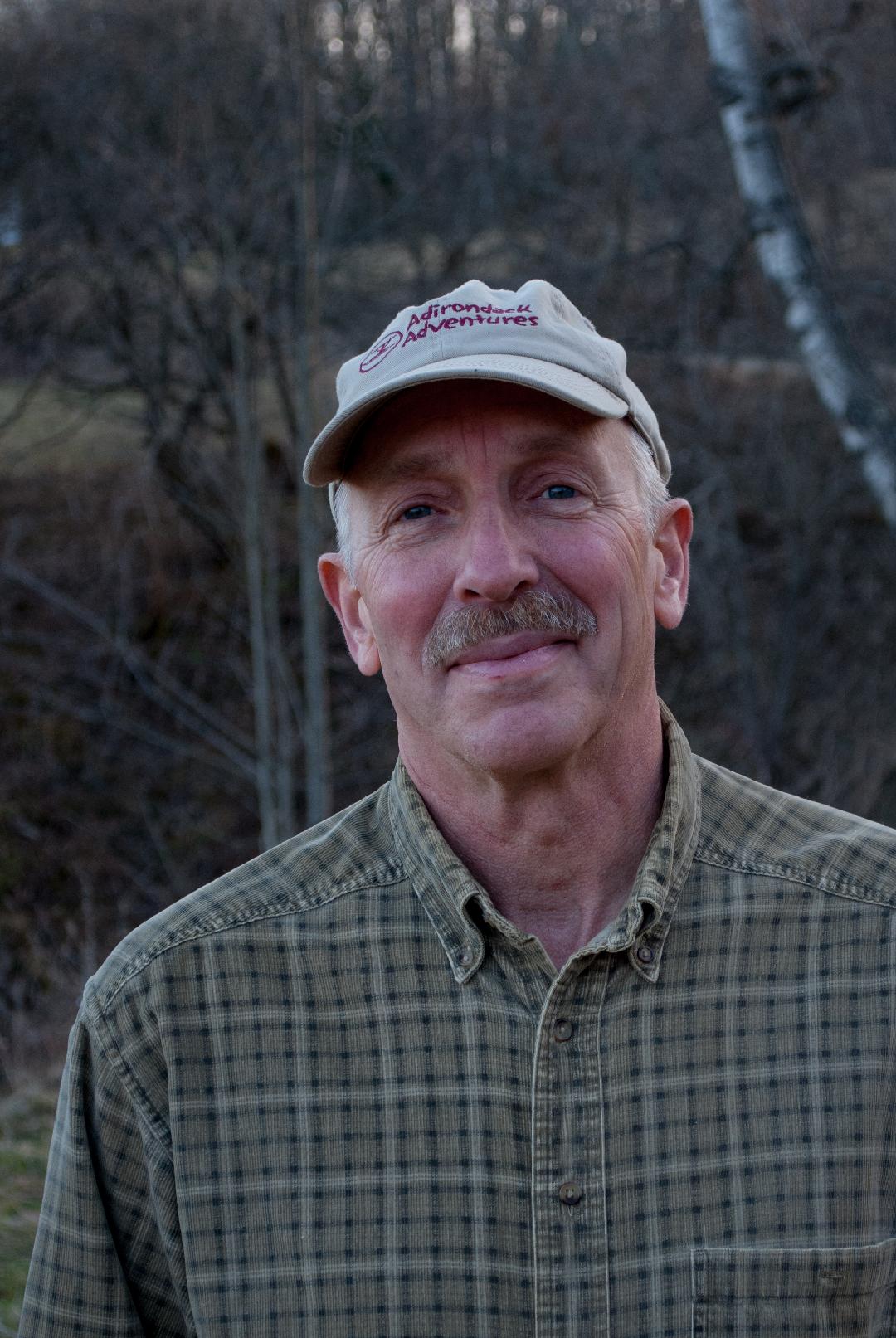
Alec Hastings (b. 1951) has earned degrees in writing and literature. He taught English for sixteen years at Whitcomb High School in Bethel, Vermont, and for two years at the Community College of Vermont. Now retired, he lives in Vermont’s hill country where he tells stories to anyone who will listen, plays the flute and sings with a band of friends, and still walks uphill in the woods he loves whenever he can. His books include Otter St. Onge and the Bootleggers: A Tale of Adventure, Rosie and the Little Folk, and Cap Pistols, Cardboard Sleds, and Seven Rusty Nails. Mr. Hastings descends from Jonas Hastings (b. 1779), an older brother of John Hastings of the Hastings Homestead.
Preface
I have always been interested in history, and now in my seventies, the past is closer to my heart than ever. I share a fascination for the old days with my friends Danny, Steve, and Eric. When we walk up on the cellarhole of a long-abandoned homestead far back in the puckerbrush, we all stand in awe of the backbone and the leap of faith it took to build a house, farm the land, and raise children in such an out-of-the-way spot. In imagining what it was like, we imagine them in some way. Some of these people were my people. When my wife Denise and I drive through New England towns, I’m wont to mention these people if they once lived nearby. She says—with fondness and a laugh—“Those blankety Hastings! They’re everywhere!” For years, my brother Duncan and I rode our motorcycles to one New England cemetery after another, tracking generations of our grandparents who left the coast of Massachusetts and moved up the Merrimack and Connecticut Rivers into the hills of New Hampshire, Maine, and Vermont. Anywhere I go, I’m surrounded by ghosts. I don’t mean Halloween, horror movie ghosts; I mean the ones we resurrect in our imaginations, the ones who did once live, who walked where we now walk, who have called out to us as we pass.
That longtime love of the past and its people led to this piece of writing. It’s the story of a time and of a man. The man was Amos Hastings. He came into this world in 1828 in Grantham, New Hampshire. He went out in Claremont in 1894. I researched, footnoted, and collected facts, all with one hope—to build a house of cards that would stand long enough for a quick look. I wanted to see, to know Amos in any small way I could. Of course, we can never bring back the dead. Even those we know in life can be a mystery at times. We can be a mystery to ourselves. How, then, can we hope to know anything about someone we never met? I don’t know. But I wanted to find Amos anyway. My attempt to meet him just once is told in the following pages. Shakespeare notwithstanding, I wanted to see him appear from that “undiscovered country from whose bourn no traveler returns.” With all my poking about in the attic of the past, Amos is still a ghost, but I glimpsed him once. I think. He was just rounding a corner. Maybe you will catch a glimpse, too.
Amos Hastings, One-time Resident at the Hastings Homestead
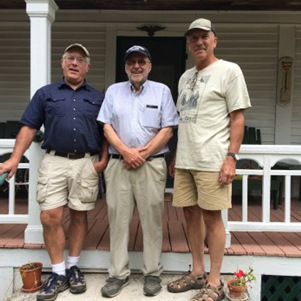
Nine years ago, I stayed overnight at the Hastings Homestead Museum. Back then, it was still the home of Stanley Russell Howe, the last Hastings descendant to live in that beautiful old house. I was passing through Bethel, Maine on my way to Nova Scotia with my wife Denise and my brother Duncan. Duncan and I had learned that our fifth great grandparents, Amos and Betsy Hastings, were buried in the Woodland Cemetery on the Songo Pond Road, so we stopped to visit their resting place. Before leaving Vermont, I called the Bethel Historical Society (B.H.S.) to ask if any Hastings still lived in the area. Will Chapman (current B.H.S. director) answered the phone and kindly put us in touch with Stan. That began a most enjoyable friendship.
Duncan Hastings, Stanley R. Howe, and Alec Hastings, 2016
Although the Hastings Homestead at 18 Broad Street was not an official museum yet, it was an unofficial one. Everywhere we looked, we saw reminders of the past. In the barn, Stan showed us the buggy that once belonged to John and Abigail Hastings, the original owners of the house. They married in 1820, became parents the following year when Gideon was born, and began building their stately home on the Common. John was Amos and Betsy’s youngest son. He was also a blacksmith, which intrigued my brother who was once a smith himself.
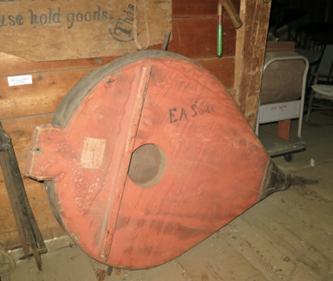
In the 1970’s, Duncan apprenticed to an old codger named Percy Bliss in the small town of Weathersfield, Vermont. Percy had learned the smith’s trade from another old codger, and no doubt there was a line of old codgers traceable to the hinterlands of time. While my head was up in the clouds seeking the hinterlands, my brother discovered a couple artifacts on the second floor of the barn. “Look at this,” he said. I came back to earth, and looked to where he was eyeing an anvil and a bellows. The anvil had a rust-brown patina and must have been treasured by whoever lugged it up to the loft because it was hefty. “I bet that was shipped here from England,” Duncan continued. Knowing he had been the acolyte of an old codger, I took his word for it. “And the bellows?” I asked. “For the forge?” He nodded.
He went back to poking around, and I returned to the clouds and sailed into the past. I was caught in a warp only Einstein could have imagined, and when I came back to earth, I found myself again at the white clapboard home on Broad Street now known as the Hastings Homestead. Behind me, the sun shone as bright as a gold coin over the Common. The maples had leafed out not long ago. In front of me, the house was almost the same as the one I had just left. Then, I saw what was missing—the portico built about 1910 to encase the front door. That was the key that turned the tumbler. I understood. I had traveled back to the nineteenth century. Don’t ask me how I knew. I strode up to the front door of the homestead John and Abigail had built not so long ago, and I knocked. I heard footsteps muffled by a carpet, and the door swung open. A woman nearing fifty stood before me in a black silk dress with white lace at the throat and a hem that almost swept the floor. Her long hair was pulled back, her gaze steady and curious. I saw strength and a hint of mischief in her eyes. I doffed my hat and introduced myself—after a fashion. “I’ve come a long way to make your acquaintance. I’m a cousin from Vermont.”
“Welcome. I’m Abigail. Calling hours begin at four, but I can see you’re a Hastings, so why don’t you step in and pay your respects to Grandmother Betsy. Then, you can say hello to John. He’s out in the shop.” She stood aside and inclined her head toward the doorway to my left. I passed through, and she returned to the kitchen.
Bellows from John Hastings’ blacksmith shop
I was in a parlor. The shades had been drawn, but light slipped through the gaps. My eyes grew accustomed to the dimness. On walls papered with a floral print hung gilt-framed paintings of sheep and cattle pastured in green meadows, the portrait of a bearded patriarch, and a deep mountain ravine cradling clouds above and plunging to unseen depths below. A piano stood against one wall, and a coffin resting on trestles was ringed by cane-bottomed chairs and two rockers. In the coffin, with her hands clasped at her waist, lay John’s mother, Betsy “Rebecca” Hastings, dressed in her Sunday best and gone to her maker at age ninety-one. [1] The date was May 13, 1846.
She had lived almost twenty years after her husband’s death, and all those years she had spent with John and Abigail. John and Abby’s son Daniel, their first Daniel, had turned one just after his grandfather passed. He would die young, of scarlet fever perhaps, but no one knew that at the time. Betsy must have enjoyed spending time with young Daniel and with her son and daughter-in-law. The help John gave his mother when she applied for Amos’ Revolutionary War pension in the early thirties suggests a close relationship. [2] When Amos died and Betsy was deciding where to live, Gideon was eight, David was six, John Decatur was four, and Daniel was one. Four little boys. I bet they were busy! Her help must have been welcome.
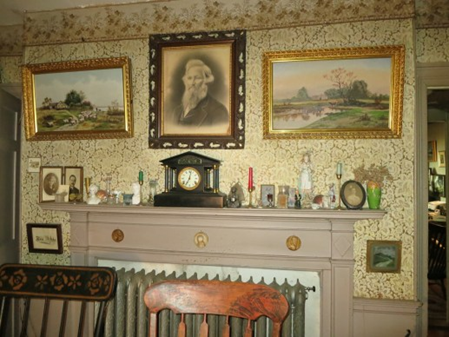
The parlor at Hastings Homestead
I was still in the world of my imagination, when I left Betsy in the parlor and walked outside. I heard the clanging of iron on iron, and I found the source of the racket in the smithy. Standing in the doorway, I gazed upon an ancient scene. John’s eldest, strapping young Gideon, pumped the bellows until the iron in the fire turned red hot. Then, his dad, he of the unruly hair, grabbed it with a pair of tongs and hammered it into shape on the anvil. John was a year shy of fifty then, and his dark hair was turning gray.
What I didn’t know—in the midst of my daydream—was that there might have been a third person in that shop. A few years after meeting Stan and finding myself agog at the time capsule that was his home on Broad Street, I made my own discovery. I was looking at Bethel’s July 24th, 1850 census records. Near the bottom of page 27, H. Hutchins, Jr.—who I imagine with wire-rimmed spectacles and an earnest expression—noted the head of the 177th household he visited as John Hastings, age 53. Beneath John’s name were those of his wife, Abigail, age 50, and his children Moses M. and Agnes Hastings, ages 15 and 12 respectively. When perusing census records, I am now in the habit of looking at the page before and page after the record I am studying. Sometimes, an interesting neighbor pops up. Sometimes a family member I might have missed, wags a finger at me from the next page.
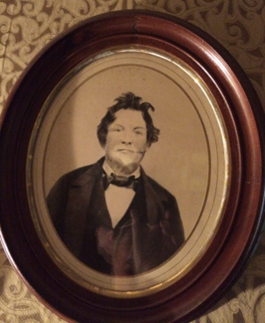
John Hastings, 1794-1859
That was what happened with the 1850 census of the Hastings Homestead. At the head of the next page, who should I find but the inimitable Daniel Straw Hastings, the bright-eyed, ten-year-old boy who would soon learn the mysteries of trigonometry, apply them to the use of a transit, and survey the Northern Pacific Railroad so “the Little Engine that Could,” actually could make the grade in the mountainous Old West. Suddenly, I again remembered my first visit with Stan. He had just brought Duncan and me into a first-floor room fronting Broad Street, a room redolent with history. Before me stood a tall display cabinet with glassed doors. I studied the curiosities on its shelves. A tin-plated canteen caught my eye. It reminded me of my youth when a World War II army surplus canteen, a jackknife, and compass were the indispensable trio in a boy’s knapsack. I knew instantly, however, that this canteen was of a much older vintage, and I sensed a ghost in the room. Moving closer, I saw the aged paper beside it and read the brown script written long ago: “… from a cleft in a sandstone cliff where a dead Indian had been lain away, about fifty miles from the Custer Battlefield… the soldier’s canteen… the spoils of battle.” Was this to be believed? Did this prosaic object once belong to one of Custer’s doomed Seventh U.S. Cavalry?
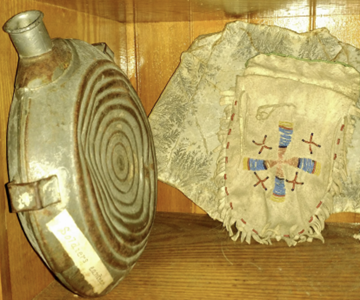
The cavalryman’s canteen
When Mr. Hutchins wrote Daniel’s name in Bethel’s 1850 census, Custer’s date with destiny was almost exactly twenty-six years in the future. Six years after that, Daniel would visit the site and find the canteen. Did he pause and see through the unknown soldier’s eyes a thousand Sioux warriors crest a nearby ridge on horseback? Did he hear their blood chilling war cries and know his goose was cooked? Daniel was very close to that day—in time, I mean. He wrote in his journal about camping at Pompey’s Pillar on the Yellowstone River in May, 1882 while he was surveying the railroad route. Apparently, it was a popular spot. Remember William Clark, the one who crossed the country with Meriweather Lewis? He and his Shoshone guide, Sacajewea, camped at the Pillar in 1806. She was still carrying her infant son, Jean Baptiste, on her back. William called him “Little Pomp” and named the rock Pompey’s Tower in his journal. Back East, editor Nicholas Biddle had the final say when he called it Pompey’s Pillar in the explorers’ published journals. Maybe he liked the repeated -P- sound.
After I meditated on the fate of the canteen’s owner, my eyes drifted back to the census and the name below Daniel’s. I did a double-take. The last person listed in the household was “Amos Hastings, 21, blacksmith.” This was puzzling. Who was this Amos? Duncan and I had come to Bethel to see the grave of Amos Hastings, our fifth great grandfather, but he was one of those contrary colonists who rebelled against the British Crown in 1775 and had been put under the sod in the Woodland Cemetery in 1829. Clearly, he was long dead in 1850. It wasn’t John’s older brother Amos either. That Amos lived in nearby Fryeburg in 1850 where his mother’s people had settled, and he was also too old to be the fellow in the census.
Who was this young blacksmith? I wondered. I looked at the entry again and saw the initials at the end of the line: N.H.—New Hampshire. Then it struck me. This Amos was my third great grandfather. He was the son of Jonas and Apphia (Baker) Hastings of Grantham, and the grandson of the Amos Hastings [3] who fought in the Revolution. I had just visited that Amos’ grave at the Woodland Cemetery. Jonas was Amos and Betsy’s first child. He was born next door in Fryeburg, Maine in 1779, two years after his father marched with Gerrish’s regiment to the Battle of Saratoga. Amos and Betsy named the boy after an uncle—perhaps a favorite uncle—who Amos knew well from his youth. His Uncle Jonas had served in Captain Goffe’s Company during the French and Indian War, and some of that service was at Fort William Henry not far from Saratoga where Amos served in the Revolution. Feeling not only the kinship a nephew has for a likable uncle, but also the respect of one veteran for another, Amos joined his Uncle Jonas in Newbury, New Hampshire—for a short time, at least—and built a homestead on an adjoining lot in the 1770s. He married Betsy in ’78, and they followed her folks, the Wileys, to Maine where young Jonas was born, and where Amos and Betsy decided to settle down. [4]
Amos and Betsy may have visited the Hastings in Newbury from time to time. If they named their first son after Amos’ Uncle Jonas, they must have wanted the older man to meet his namesake. By the same token, they would have wanted young Jonas to meet his uncle and his other Newbury relatives. Whether Jonas’ interest was piqued by a visit or by stories of that branch of the family, he returned to his father’s old haunts when he came of age. He stayed long enough to court Apphia Baker who lived on Baker Hill (just south of Hastings Hill, now Sunset Hill) on the eastern shore of Lake Sunapee. When Jonas “popped the question,” Affie accepted. They married in Maine—probably in Bethel—in 1802 and lived in Bethel and Mercer until 1813. In that year, their fourth child, William Henry Harrison Hastings [5], was born back in Newbury. Jonas and Affie bought land in Grantham, New Hampshire in 1818, and moved to town that same year.
And that brings us back to the twenty-two-year-old Amos living at the Hastings Homestead in 1850. He was, indeed, from New Hampshire, and born to Jonas and Affie in Grantham. The proof that young Amos of Grantham was the same Amos staying with John and Abigail came when historian Randy Bennett discovered a letter at the Homestead. In this letter, written in February, 1851, John’s older brother Jonas asked for news of his son. The name of the son, of course, was Amos, the same young man who had come to Bethel from Grantham to learn the blacksmith’s trade from his uncle and his cousin Gideon.
On the Beach
Amos’ gravestone in Claremont, New Hampshire’s Pleasant Street Cemetery gives his birthdate as February 16, 1828. I never met him, of course. He died sixty years before I was born. I do remember meeting his grandson, Oliver Amos, my great grandfather. Oliver’s father, John Amos, “farmed him out” in 1887. John Amos’ wife, Mary Addie, had just died in childbirth, and John placed the three oldest kids in other “situations” to earn their keep. Oliver was eleven. My brother Duncan remembers hearing that Great Gramp Oliver ran away from an old couple who “used him hard” on their farm. I remember hearing that he was taken in by the Shakers in Enfield, New Hampshire next door to Grantham. Maybe he spent time in both places. Maybe neither. Memories can become porous in the hands of the elderly.
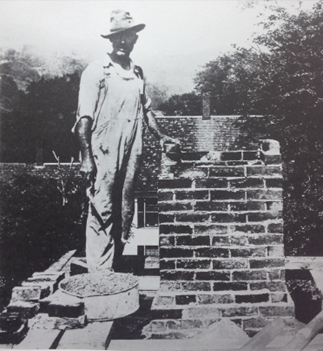
Oliver Amos Hastings, 1876-1964, McIndoe Falls, VT
My Grandfather Scott Hastings, Sr., one of Oliver’s sons, never talked much about the older generations of his Hastings family. I figured his reticence about his people was part and parcel of being close-mouthed and tight-lipped. Now, I’m not so sure. Maybe he didn’t know much about his forbears. His father would have had to pass down those stories, and Oliver may not have had many of them to pass on. He was sent off to God-knows-where when he was young and missed seven years in the lives of his dad and brothers and sisters. Quite a few pages in the family story were blank for him, I suppose.
Now, let me do an about-face and say that, even though I have called Gramp a man of few words, he could be a natural-born storyteller if his tongue was loosened. He spun some of his best yarns when his younger son Robert showed up. Dad’s younger brother usually rumbled up our dirt road unannounced and co-incidental with twilight on a summer evening. His arrival brought a tremor of excitement, even a hint of illicit possibility. I don’t mean he was a full-blown miscreant. There can be a fine line between mischief and outright bad behavior, and it wouldn’t surprise me to learn that Uncle Bob walked close to that line, but he wasn’t bad—not in my book. I don’t know why I am left all these years later with the sense that he had a “reputation,” that he was, in the eyes of some, perhaps, a black sheep. Later, I became a black sheep myself for a time, so I may be seeing the past through my own, colored lens. I certainly never heard what he might have done to justify any such judgment—if, indeed, he had done anything—so with no hard evidence, I liked him instinctively and remember him fondly to this day. His mother’s Italian and father’s Yankee features combined in a handsome face. He was always happy to see my brothers and me, always telling stories and laughing and making the rest of us laugh.
It may have been during one of Uncle Bob’s visits that Gramp first mentioned his great grandfather, Amos. Like as not, Dad and Gramp and Uncle Bob were sitting around the round table in the kitchen of the old farmhouse with juice glasses and an unfamiliar, amber liquid in a tall, narrow-necked bottle. I knew this because I had crept down the backstairs in the old farmhouse and peeked. Then, I sat on the bottom stair and listened to their talk and the clink of glasses. As the liquid lowered, the stories came up out of the well. Dad talked about seeing Lebanon’s last Civil War veterans marching down the street on July 4th or sitting on a bench outside a Main Street newstand, faces lifted to the warmth of the spring sun. It may have been during one of these talks that I first heard about a grandfather Hastings who fought in the War of the Rebellion. His name was Amos. That was all I knew about him for many a year.
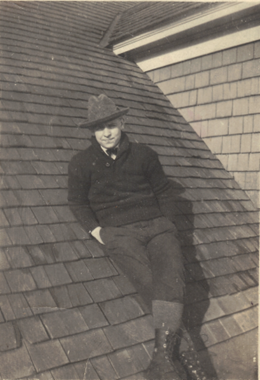
Oliver’s son, Scott Hastings, Sr., 1904-1991, paper mill boarding house, East Ryegate, VT (circa 1925)
Now, I know more. I remember his grandson, Great Gramp Oliver very well. In the 1950s and ‘60s when my brothers and I were growing up, Dad sometimes drove our Chevy Fleetline from Woodstock to White River Junction, and then up Route 5 along the Connecticut to Wells River, a place—as Dad once put it—“east of the sun and west of the moon.” [6] It was a pilgrimage, and at the end of it were our great grandparents, Oliver and Lena Belle, who looked like apple dolls. Now, when I look back, I realize Dad was very fond of his grandparents, that he had good memories of times spent in their company. He wrote vividly of those times. Here is an excerpt from his memoir:
“… at evening chores in the long midwinter nights he [Oliver] and Indian Joe, pitching hay down from the mows in the dim radiance of a kerosene lantern, heard the rafters creak under the weight of the falling snow piling up on the roof. Then the barn became a self-contained world in which the hiss of sliding hay and the desultory stamping of the horses marked the passage of time. The drifting path outside was the only sign of continuity with the life of the house.” —Goodbye Highland Yankee
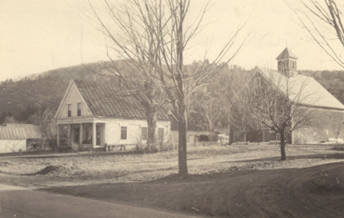
Oliver & Lena’s farm (with barn), McIndoe Falls, VT
I was twelve when Great Gram died in 1963 and thirteen when Great Gramp followed her a year later. I can still see Great Gramp’s face just before he passed. Dad walked my brothers and me around the outside of the nursing home in Haverhill, New Hampshire. The sun streamed through the large window of his room, and his face lit up like a bright summer morning when he saw us. Sixty years later, I can see the joy in his eyes as if I am seeing him now.
This is why I feel sure Great Gramp Oliver knew and remembered his Grandfather Amos. Oliver was eleven when he was sent away in 1887, but he was still living with his family in Claremont in ’82. His grandparents, Amos and Nancy, moved back there from Ely, Vermont at that time. Nancy died there in ’84 when Oliver was eight. Oliver would have three more years in Claremont before his mother died, and he was dropped like the stork’s bundle into a new “situation.” Living in the same town, he must have visited his grandparents enough to remember them well, especially Amos. If he was allowed to return to Claremont now and then after his mother’s death—maybe at Thanksgiving or Christmas—he might have visited Amos before the old man died in ’94. Distance wouldn’t have been an obstacle. If Oliver was allowed to visit, he could have taken a train to Claremont by himself from any number of the river towns to the north where he was living. Youngsters of that day grew up fast. Grampa Scott told me he was driving a team for George Van Dyke’s lumber company and sledding logs out of the woods at the age of fourteen. That would have been in 1914.
Maybe I have belabored all this “chain of family” that links me to my third Great Grandfather Amos, but for me it was all part of a discovery. Gradually, Amos and Nancy became real in some incorporeal, mysterious way. I began to care about them. They were no longer names I was adding to a family tree in the way one might place pieces in a jigsaw puzzle. I’d always known I had ancestors, of course, but as I learned more and more about them, as they became people, I felt like I had just changed seats in the world’s bleachers. I could see more of the playing field. I was no longer a single grain of sand on the beach of time. I was part of the beach, and the beach stretched out of sight into the past in one direction and into the unknown future in the other. It was just that little bit of comfort to be part of the beach rather than to be a single speck in the universe.
Thunder in the Distance
Except for one extraordinary, historic moment known as the American Civil War, Amos Hastings was an ordinary person who left scant evidence of who he was, his beliefs and character, his hopes and dreams, his triumphs and failures, all that makes us uniquely who we are. He may have written letters or journal entries that have disappeared or remain in a box waiting to be discovered, but I have found only one instance in which he speaks to us from the past. It is a single letter written to the Bureau of Pensions in 1884. Other than this letter, his life boils down to a grocery list of census records, an enlistment paper, two pension applications, a deed, a birth and a death certificate, and some of his children’s vital records. Without more help from Amos himself, I was in a quandary. How could I gain insight into who he was? For lack of a better plan, I decided to “walk in his shoes” from one town to the next, decade by decade, to see, as best I could, who he was from where he went and what he did.
If one celestial sphere arced upward from Amos’ morning, shone blood red at noon, and winked out in the twilight, it was Mars. The god of war was buckling on his sword when Amos was born in 1828. Slavery was growing in America like a noxious weed. Whitney’s cotton gin and the textile mills of Lowell, Massachusetts brought on the Age of Machines. The wheels of progress spun faster and faster and became a blur. Factories spit out people’s goods like a Gatling gun, cheap and easy. It was a grand vision except that its success hinged on a deal with the Devil: slavery. As South Carolina’s unsavory, unscrupulous Senator Hammond put it, “Cotton is King.” [7] He defended slavery with handsomely dressed but specious arguments, and when all was said and done, the simple truth was that slavery was wrong no matter how craftily men like Hammond tried to say otherwise.
Not everyone stood idly by while slaveowners spouted hypocrisy. The nineteenth century’s Second Great Awakening not only included people wanting re-inspired Christianity, but also those who wanted Christianity to do some practical good. Many of the newly-awakened felt America needed to be re-formed, and a good place to start was the abolition of slavery. The Quakers led the way. They practiced what they preached and acted to abolish slavery. As early as 1790, they petitioned Congress to end slavery, publicized its evils, and helped slaves escape from their owners. The Unitarians, Methodists, and Congregationalists were generally against slavery, but factions disagreed on how fast and in what manner slavery should end. Nevertheless, through the thirties, forties, and fifties when Amos was becoming a man, abolitionists—a small but dedicated group drawn from across America— created a tide that rose higher and higher and carried the country inevitably toward a showdown.
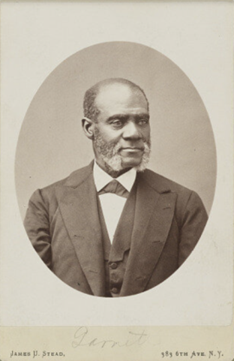
Henry Highland Garnet, 1815-1882, abolitionist
Hear your language, proclaimed to the world, July 4th, 1776—“We hold these truths to be self-evident—that ALL MEN ARE CREATED EQUAL!! that they are endowed by their Creator with certain unalienable rights; that among these are life, liberty, and the pursuit of happiness!!”
He, and other abolitionists, were anathema to the South. Slave revolts were a scary prospect, and the proof came two years later in ’31 when a black preacher named Nat Turner and his followers killed fifty-five white people in Virginia. Abolitionists weren’t necessarily popular in the North either, especially in New England. A lot of Yankees manufacturing cloth were suddenly making a good living from cotton—especially the mill owners—and if slavery was abolished, who would pick that cotton? Walker died of consumption in 1830, but two more editions of his “Appeal” were printed that year, and in ’31, William Lloyd Garrison began publishing the abolitionist newspaper, The Liberator. The fight to end slavery had begun in earnest, and it slowly gained momentum during the first half of Amos’ life.
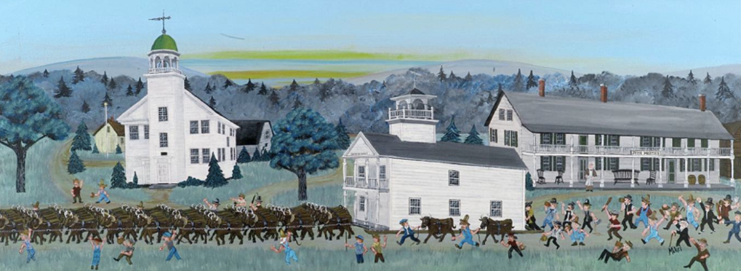
For the next thirty years, America talked about the pros and cons of slavery at the dinner table, on Main Street, and wherever else people gathered. In 1835, a conflict over race occurred almost on Amos’ doorstep. Henry Highland Garnet, who would reprint and re-popularize David Walker’s “Appeal” in 1848, enrolled with other young African Americans and whites at Noyes Academy in Canaan, New Hampshire. Locals, who could not abide mixing the races, dragged the school off its foundation with oxen, moved it down the main street of the village, and destroyed it in the months that followed. This was Amos’ America.
Noyes Academy Removal by Mikel Wells, Source: Canaan Historical Society
It was a time of confusion, fear, anger, racism, and conflict. Outspoken President Andrew Jackson was at the center of it for much of the 1830s. Amos’ older brother, Benjamin Baker Hastings and his wife Eliza, named a son after Jackson during the President’s second term. “Old Hickory” was a hero to many Americans because he “beat the bloody British at the Battle of New Orleans” [9] in 1815 and also because he opened voting to all white men, not just those who owned property. He wasn’t a hero to all Americans, however. He owned slaves and signed the Indian Removal Act which banished the Cherokee, Choctaw, and Seminole from their ancestral lands to the Indian Territory (later, Oklahoma). Thousands of Native Americans died on what would be called “The Trail of Tears.” President Jackson was admired by some as a man of the people, but he was also reviled as a demagogue by others.
A figurative “trail of tears” continued for the next twenty years, not only for Native Americans, but also for African Americans, and for all the people who were being run down and run over by the wheels of progress rolling sometimes recklessly down America’s Main Street. Americans were still taking part in an argument about freedom, equality, and other idealistic notions that had started during the Revolution. Even the Founding Fathers had not solved the problems springing from these ideas, and in the decade before the Civil War, the “new fathers” were doing no better.
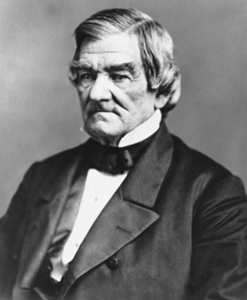
John Ross, 1790-1866, led the Cherokees’ resistance to the Indian Removal Act, 1830
That was clear at the Hastings Homestead when Amos came to the breakfast table one morning in 1850 and saw his Uncle John reading a headline in the local paper: “Congress Passes Fugitive Slave Act.” While running for President two years later, New Hampshire’s Franklin Pierce reminded the public that he had supported the act. At his inauguration, he repeated his belief that it was each state’s right to say yes or no to slavery: “I believe that involuntary servitude, as it exists in different States of this Confederacy, is recognized by the Constitution.” [10] I wonder why he didn’t say “slavery” instead of “involuntary servitude.” Was he fooling himself? Maybe his death in 1869 was not only hastened by drink. Maybe he regretted using the Constitution to justify slavery. Slavery wasn’t just a legal question; it was a moral one, one the Constitution hadn’t resolved. He must have been a good enough law student to know that. Instead of helping to stop the runaway train, he greased the tracks. War was at the end of the line.
The new law required Northerners to return runaway slaves to their Southern owners. Many in the North were outraged. Four years later, Pierce also signed the Kansas-Nebraska Act which reneged on the Missouri Compromise, an 1820 law forbidding new slave states above a latitude of 36° 30”. With this latest act, Kansans could use the “states rights” argument to ignore earlier federal law. They could vote “yes” to slavery if they wished. The game was rigged, however. Pro-slavery Border Ruffians from Missouri crossed into Kansas, stuffed the ballot boxes, and stacked the political deck. That triggered a vicious war known as “Bleeding Kansas” between the Ruffians and the Free-Staters.
For those who still believed in the dream of freedom for all, signs of hope still appeared like crocuses in a New England spring. In 1852, about the time Amos and Nancy were getting married, an American abolitionist named Harriet Beecher Stowe published her novel, Uncle Tom’s Cabin. Before her book, abolitionists wrote opinion pieces to capture people’s minds. Harriet wanted to capture their hearts. She succeeded. Uncle Tom’s Cabin was the most popular novel of the nineteenth century. The only book of any kind to outsell it was the Holy Bible. When Harriet visited President Lincoln soon after the Battle of Antietam in November, 1862, Lincoln supposedly said, “So you’re the little woman who wrote the book that made this great war!” [11] Whether Lincoln greeted Harriet this way or not, the words had the ring of truth. Her novel caused untold numbers of people to support the abolition of slavery. She was living in Brunswick, Maine where her husband Calvin was teaching at Bowdoin College. Coincidentally, Joshua Chamberlain, one of Calvin Stowe’s students, graduated from Bowdoin that year. In 1862, twenty years after leaving college, he would enter a new classroom. He and Amos Hastings would both experience the Battle of Antietam. In July of ’63, Chamberlain would become a hero at Little Roundtop during the Battle of Gettysburg. Like Amos, he was born in 1828.
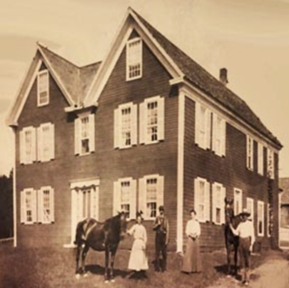
Abolitionist George Kimball’s “Twin Gables,” Underground Railroad stop in Canaan, NH
While Harriet Stowe was busy writing Uncle Tom’s Cabin, a New Hampshire man named Timothy Manchester was busy farming and raising twelve children with his wife Maria. They lived in East Enfield, Grantham’s neighbor to the north, and Tim believed, like Harriet, that all people should be free. He believed this so strongly that he became an agent on the Underground Railroad. So did some of his neighbors in Canaan, and so did Harriet Beecher Stowe who hid slaves in her house in Brunswick as they made their way to Canada. [12] Amos probably heard about Harriet and her novel at some point—it was a bestseller—but he didn’t know about Tim and his risky venture in 1850. He would know soon enough.
Sometime between 1850, when Amos finished his apprenticeship in Uncle John’s shop, and December 1853, he and a young woman named Nancy Sawyer tied the knot. I haven’t seen their marriage certificate, but not many people started a family back then without saying their wedding vows first. Since their daughter Roseline was born in Grantham in ’53—probably in the home of Amos’ parents, Jonas and Apphia—I’ll go on thinking they were husband and wife. [13] And since Nancy’s older sister Maria was married to Tim Manchester and living next door in Enfield, Amos must have met his brother and sister-in-law, either when he and Nancy were betrothed, or when Rose was born. No doubt, Amos learned about Tim’s work as a “conductor” on the legendary railroad, and he tucked that under his cap to think about at his leisure.
Timothy Manchester, 1804-1880, agent on Underground Railroad, Enfield, NH
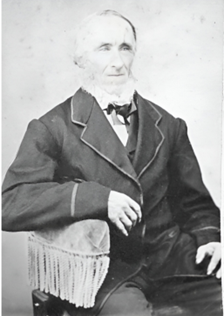
And what did Amos think when he learned Tim was an abolitionist? Anyone helping a slave escape could be arrested, fined a thousand dollars, and sentenced to six months in jail. [14] A thousand dollars at that time was a more-than-sizeable sum. Using an inflation calculator, the lowest equivalent I could find in today’s money was $28,000. Tim would have been ruined if he’d been caught. Since Amos enlisted in the Union Army ten years later, chances are he wasn’t much troubled by Tim’s clandestine activity. He may have heartily approved.
Many New Hampshire folks—including Amos—were exposed to the opinions of local abolitionists when they were published in the newspapers or expounded from the pulpits. They heard and considered the words of Nathan Rogers, a co-founder of Noyes Academy and the editor of Concord’s Herald of Freedom, the sermons of the Methodist minister George Storrs of Lebanon, the provocative arguments of Stephen Foster of Canterbury, and the articulate tracts of Parker Pillsbury whose “pen… [was] always sharpened against wrong and injustice.” [15] What did the people of New Hampshire think of abolition? They were still trying to figure that out at the end of the ‘50s.
Grantham’s Union (Methodist) Church had an abolitionist minister in 1852 and ’53 about the time Amos and Nancy’s daughter Rose was born. Reverend Charles Lovejoy may have taken the position comforted by knowing a female, anti-slavery society had formed there almost twenty years earlier. [16] Some of Amos’ family were Methodists and may have been abolitionists. [17] Grantham had two Methodist churches. One of them was in North Grantham near the farms of Amos’ parents and his Uncle David and Aunt Abiah Hastings. If any of the Hastings attended the Methodist church while Lovejoy preached, they probably heard abolitionist sentiments expressed.
Reverend Lovejoy, his wife Julia, and their three children moved to “Bleeding Kansas” in ’55. They landed in the middle of the fight between Border Ruffians and Free Staters. It was a prelude to the coming bloodbath known then as The Great Rebellion (a.k.a. Civil War). In 1856, they lived in an abolitionist settlement named Osawatomie after the Osage and Pottawatomie tribes. It was John Brown’s headquarters, and when he retaliated against the Border Ruffians for their attack on Lawrence, they soon replied in kind. So began the worst of a back-and-forth round of murder, pillage, rape, and the litany of other violent acts people have always committed against each other when they can’t settle their differences peaceably. This entry from Julia’s diary gives the tenor of the times:
“Our hearts sicken at the atrocities perpetrated daily upon the innocent and unoffending. Ossawattamie has been laid in ashes, every house burned, and four of our men killed. Fifty Ossawattamie families shelterless, are now living in their wagons in the woods, endeavoring to escape these fiends in human form…! This was a beautiful town, about the size, I think, of Lawrence. Jude Wakefield’s house and four of his neighbors were burnt night before last. The ruffians have burnt every Free State man’s house in Leavenworth, pressed the men into their service, at the peril of their lives, driven the women and children, with just the clothes on their backs, into the boats and sent them down the River. Children with no parents to take care of them, were pushed into the boat and sent off too!” [18]
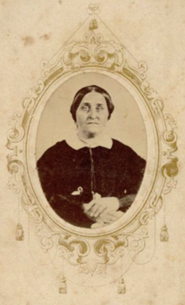
Julia H. Lovejoy, 1812-1882, abolitionist writer in “Bleeding Kansas”
Amos’ older brother Benjamin Baker Hastings, and his wife Eliza may also have been abolitionists or at least sympathetic to the cause. Five of their sons served in the Union Army. Ben was born in 1804, twenty-four years before Amos. The younger brother may have looked up to the older, and they may have talked about slavery and what should be done. In 1855, two years after Rose was born, Ben deeded two acres of land to Amos. The lot abutted the Methodist parsonage in North Grantham. From 1859 until Amos enlisted in the Union Army in ’61, the brothers were neighbors and visited each other when their busy lives allowed. Amos and his family lived in Northville, a hamlet of Newport not far from Grantham. He worked as a blacksmith at the Sibley Scythe Factory on the Sugar River. Ben and Eliza owned a farm only a mile away. If Amos did look up to his older brother, he would have had reason. Ben and Eliza’s son Elijah was a Civil War veteran like Amos and also a successful lawyer who moved to Cherryvale, Kansas in 1878. An account of him in the History of Montgomery County, Kansas mentions their good reputation and their membership in the Methodist Church:
Benjamin was a farmer and millwright during his life and most favorably and widely known in the New Hampshire hills…. They [Ben and Eliza] were devout and consistent members of the M.E. [Methodist Episcopal] church and widely respected in their community.
During the first thirty-three years of his life, these people and events were the cards he was dealt, the hand he would play. Aces, jacks, and deuces, they would add up to a decision. Did he believe in the Union? Did he believe in freedom? Eventually, he would lay his cards on the table.
Storm on the Doorstep
William Butler Yeats wrote “The Second Coming” in 1919, but the poem could describe Amos’ America as easily as Yeats’ Europe after World War I:
Things fall apart; the centre cannot hold;
Mere anarchy is loosed upon the world,
The blood-dimmed tide is loosed, and everywhere
The ceremony of innocence is drowned;
The best lack all conviction, while the worst
Are full of passionate intensity…
What rough beast, its hour come round at last,
slouches toward Bethlehem…?
Amos and his generation of Americans were awakened each morning by the footsteps of that rough beast. It shook the ground. In the 1850s, especially after the Kansas and Nebraska Act, people finally saw the monster clearly. Not far down the road, it lumbered out of the shadows, murder in its eyes. It was war.
We now have glimpses of Amos’ America, of the people around him, but what kind of man was he? What did he believe? What did he value? Two letters found at the Hastings Homestead offer clues. Amos’ father, Jonas Hastings, wrote the first. It is the letter mentioned earlier, the one he sent it to his younger brother John at the Hastings Homestead in 1851:
“I should have directed this letter to Amos, but I do not know for a certainty where he is but suppose he makes his home at your house—we have not had a letter from Amos since he left Grantham but have heard from Mr. Durkee that he was unwell or had a sore on his face or something of that sort—but we are in hopes that he is well by this time…. I should like to have you inform me in particular how Amos is doing, whether he is industrious and economical, and if he is of good habits and morals.” [19]
Jonas was seventy-two when he wrote this letter. I am seventy-three with children of my own, and as I write these lines, I feel a kinship with both Jonas and his son, both of them my grandfathers. I remember my own parents prizing the same Yankee values as Jonas, and I remember passing on similar sentiments to my own kids. The plea boiled down to, “Work hard and be good.” By the time Jonas wrote to John, Amos was the last of his eleven children to leave home, the youngest, and apparently one he worried about. Any father, I think, can understand his concern. Later in the letter, he reveals a sense of urgency when he asks that John or Amos write “back immediately.” Maybe that was because neither he nor Amos’ mother Apphia were getting any younger. Affie’s health may have been fading by ’51. She would die less than two years later in May, 1853. When Jonas asked about Amos’ conduct and good habits, was he also concerned about the kind of man Amos would become? Had Amos left home under a cloud? It’s likely that Jonas had some reason for these questions. What it was and how serious it was, remains a mystery.
Amos’ nephew, Andrew Jackson Hastings, didn’t think much of his uncle. He was the author of the second letter found at the Homestead. When he replied to a letter from Daniel Straw Hastings in the early 1900s, he was blunt. He said, “My uncles, with the exception of Amos, were all men of sturdy character.” What lay behind this remark? Was it sanctimonious gossip, or was it valid? Did he and his uncle, only eight years his senior, have a bone to pick? Was Andrew’s opinion of his uncle fair, or did it reflect an uncharitable side of his own character?
I don’t know the answers to these questions. I would love to see John’s letter of reply to Jonas or Daniel’s reply to Andrew if they should ever surface in someone’s attic. Daniel was ten when his cousin Amos lived at the big house on Broad Street in 1850. Amos, at twenty-two, was on the threshold of manhood. He had come to his Uncle John’s home in Bethel to learn the blacksmith’s trade. Was he a bit of a black sheep like my Uncle Bob when he arrived? Like me? Did Jonas and Apphia send him there hoping John and Abigail would be a good influence? If he caroused as a young man in Grantham, did he do so under his uncle and aunt’s roof. I wonder. People worked long hours back then, at least ten hours a day, often more. No doubt Amos was tuckered by quitting time. That, by itself, might not have stopped him from kicking up his heels, but he probably lacked cash as well. Most apprentices were given room and board and the chance to learn a trade, but they weren’t paid. If Uncle John gave Amos any money, it’s likely to have been a modest sum and hard-earned at that, especially if John had been advised that Amos might be a “prodigal” sort of son.
Another consideration is the influence of his Aunt Abigail and Uncle John. Unless Amos’ character was seriously flawed, he wouldn’t have wanted to disappoint them. Feeling gratitude and respect for their kindness, most nephews in his place would have behaved reasonably well. My guess is that Amos took his apprenticeship seriously. After all, he buckled down to work as a smith for the next eleven years. Maybe he learned more while living at the Homestead than just smithing. Perhaps Uncle John and Aunt Abigail, his young cousins Daniel, Agnes, and Mason, and Cousin Gideon’s family next door all helped him “straighten out”—if straightening was needed.
Daniel—judging from his later writings and achievements—grew up to be an upstanding man. He and Amos ate at the same table and saw each other daily. They must have known each other quite well, as well as a boy of ten and a young man coming of age can know each other. Did Daniel see Amos as a decent sort? I’d love to know.
The Cards
This much we do know. Amos didn’t lack courage and he wasn’t a quitter. That’s clear from his military record. In 1861, he left a wife and four children behind in New Hampshire and volunteered to serve in the Second Regiment of United States Sharpshooters at the age of thirty-three. Why did he leave his family to fend for themselves? My wife Denise asked me this question. It was hard for her to understand how a man could do such a thing. I can only speculate. How does one look back through the lens of the twenty-first century and understand Amos’ thinking in 1861? Was it for a soldier’s pay or a signing bounty? The call of duty? Adventure? A chance to get away from his family responsibilities? The abolition of slavery? Maybe the words of a contemporary will help. Captain Charles Stevens of the First United States Volunteer Sharpshooters said:
“It was a momentous era in American history—the life struggle of the nation. Everybody realized the danger, everyone saw the necessity of promptly meeting it. So earnest had the people become… that more than double the number asked for enlisted….” [20]
“More than double the number asked for”—that’s hard to imagine now. Let’s go back to Amos’ time, just before the war and keep imagining his time. In 1858, Amos’ brother Ben and sister-in-law Eliza bought the Silas Wakefield farm near Northville in the Town of Newport. Thanks to industrious settlers, Northville prospered in the 1830s and ‘40s, and was a thriving village by the time Ben and Eliza arrived. Their farm had belonged to Silas twenty years earlier, and he and some of his family were pillars of the town. Silas helped bring Claremont’s Argus newspaper to Newport where it was joined with Cyrus Barton’s Newport Spectator in 1835.
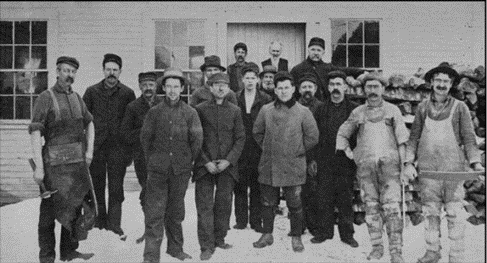
Sibley Scythe Factory employees (man at right and in front of door may be owner, Ezra Sibley)
People were hungry for news, and the news was suddenly at their fingertips. The telegraph came to New England with the railroads in the forties and fifties. The latest news could be tapped out on the operator’s keys with Samuel Morse’s code at one end of the wire, and somebody could decode the message at the other end instantaneously! Like most Boy Scouts of my generation, I learned some Morse Code as a youngster, especially dot-dot-dot-dash-dash-dash-dot-dot-dot—the international distress signal, S-O-S. Once the so-called “lightning presses” were invented—again in the forties and fifties—widely-available newspapers gave events an immediacy never felt before. People all over America were reading about history almost as it happened!
That’s why Silas’ help in bringing the Claremont paper to Newport was important. Responsible reporting like that found in the Argus & Spectator was informing his neighbors, and better information meant better decisions. Silas’ cousin Josiah, another admirer of the written word, was providing greater access to that weighty cousin of the newspaper—the book. He “kept the library in Northville” for years and was thought to be a “man of excellent judgment….” by his neighbors. Josiah died in ’36 and Silas in ’38, but Josiah’s brother Peter lived until 1851. He was a millwright and a Methodist. When he decided Northville needed a chapel for worship, he built one. [21] Ben Hastings was a millwright himself, and both he and Eliza were Methodists. No doubt they, along with many other Newport folk, held Peter in high regard.
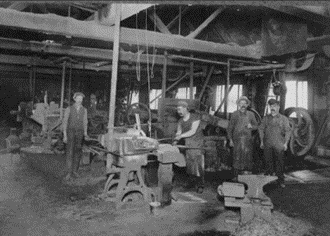
Inside the Sibley Scythe Factory, North Newport, NH
When Ben and Eliza moved to Northville in ‘58, they still had Andrew, Lyman, and Eliza at home. Their daughter Elvira married Frank Taylor in ’59, and the newlyweds lived with Ben and Eliza as well. Frank and Andrew worked the farm with Ben who was in his mid-fifties. Within a year, Amos and Nancy Hastings moved to Northville from Lebanon where they had been living not far from Nancy’s older sister Maria and her brood of Manchesters. By this time, Amos and Nancy’s family was growing, and maybe with three youngsters—John Amos, Rose, and Frank—they moved so Amos could take a better-paying job. Northville was hopping! At one time or another, the mills on the Sugar River were making scythes, pails & tubs, barrels, bobbins, rakes, shoe pegs, hames, doors, sash & blinds, lumber—you name it. [22] Amos hired on at Sibley’s Scythe Factory as a blacksmith. He and Nancy lived in the village near the owner, Ezra Sibley, so Amos could walk to work.
Northville was a mini-mecca for Hastings at that time, especially those who were finding it hard to scratch out a living on hill farms with more stones in the ground than potatoes. They moved to Northville, not only from Grantham, but also from the Hastings Hill neighborhood in Newbury. James Wood Hastings, a shoemaker, and Richard Meigs Johnson Hastings, his younger brother, were among those coming from the east side of Lake Sunapee. Richard M. J. worked with Amos at the scythe shop in 1860. Amos’ grandfather—the Amos of Bethel, Maine—was a half brother to Richard’s grandfather Levi, so they were cousins. Richard lived with his one-time uncle and current stepfather, Jonas Hastings (yet another one!), his mother Lydia Hastings, his sixty-year-old Aunt Lydia Hastings (sister to this Newbury Jonas), and his eighty-nine-year-old grandmother Phebe Hastings, the wife of Levi who had died almost twenty years earlier. It was a houseful! Richard was nine years younger than Amos. He enlisted in the United States Navy in ‘62 and served aboard the U.S. steamships Ohio, Augusta, and Princeton.
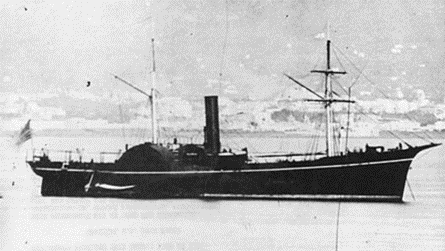
Richard Hastings, 1837-1905, served aboard the U.S.S. Augusta for a year
This was Amos’ situation in the spring of 1861. Rumors of war were soon rumors no more. The South had attacked Fort Sumter on April 12, 1861. Newport’s weekly, the Argus and Spectator, broke the story in the days following. On April 15th, Lincoln declared an insurrection was taking place and called for seventy-five thousand soldiers, the so-called “three-month men.” By May 3rd, he was already looking further down the road and calling for 42,000 more troops. All the enlistees—even those who signed in April—were now to serve three years rather than three months.
Amos didn’t rush to enlist. In the spring of ’61, he may have thought, like others, that the South’s rebellion was more smoke than fire. Many of the three-month men may have thought they’d come home in time for haying in August. No one dreamed the fight would last until Christmas. That thinking changed fast. As it turned out, the Union victory would not come for four years, and when it did, even the victors knew they had lost much. It would take generations for the country’s wounds to heal, and the scars from that bitter war are with us yet. After Lee surrendered at the Appomattox Court House, the letter of the law for the United States finally lived up to the Founders’ declaration of “liberty for all.” Those who believe in that dream are still trying to fully achieve it today, not only in the letter of the law but in people’s hearts everywhere.
One of the men who signed up in May was twenty-year-old Jonathan Merrill. He was Amos’ younger, second cousin. Jon’s grandfather—also Jonathan Merrill—was Elizabeth (Merrill) Baker’s brother. Elizabeth was Amos’ grandmother. In two years, Jon would marry Mary Minerva Hastings, the daughter of Sam and Phylura Hastings who lived on Burpee Hill Road about a mile from Amos’ parents and within a stone’s throw of the Hastings Cemetery and the Methodist parsonage. It will come as no surprise—Sam and Amos were related. Sam’s father David and Amos’ father Jonas were the original Hastings to settle in Grantham with their families in 1818. The war had come to roost on Amos’ doorstep. He knew Jonathan’s family well, and Mary’s even better.
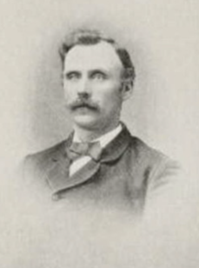
Jonathan Abraham Merrill, 1841-1926, 2nd NH Infantry
Jonathan and his older brother Noah both enlisted with the Second New Hampshire Infantry regiment after the attack on Fort Sumter in mid-April. They mustered in on June 2nd. According to Jon’s enlistment record, he was a tall drink of water, six feet, one and a half inches in height with blue eyes and light-colored hair. On July 21st, Confederate troops tangled with the Union Army at the Battle of Bull Run. The result was a shock for the North. Some Congressmen had come with their wives to picnic nearby and watch the battle through binoculars. With the arrival of General Johnston’s Rebel reinforcements, they realized the Union was not going to whip the Confederacy that day. The picnickers had to beat a hasty retreat across the Potomac or find themselves the guests of unwanted hosts in Richmond.
Jon and Noah were there with the rest of their regiment at Bull Run. Like the Congressmen and the other Union troops, they hightailed it for Washington twenty-five miles away. It had seemed unthinkable days earlier, but now Confederate troops were on Washington’s doorstep. Would the capital fall? It no longer seemed a farfetched notion. More troops were rushed to Washington by train. Following the orders of General Dan Woodbury, who grew up in New London, two towns east of Grantham, the new recruits laid their muskets aside, took up pick and shovel, and dug more redoubts and gun emplacements. In recognition of his gallantry at Bull Run, and because he was a West Point engineer, Daniel was tasked with building the Arlington Line, a ring of forts around the capital.
Weeks turned into months, months into a couple years, and Jon chalked up his hopes for a “brief adventure” to the caprices of war. His brother Noah was wounded and captured at the Second Battle of Bull Run in late August of ’62. He died about two weeks later, the day before Antietam. The top brass ordered Jon and the Second Infantry back to New Hampshire at the beginning of ’63. On furlough in April, Jon wed Mary Hastings in Grantham. Neither was a stranger to the other. Jon’s Aunt Abiah (Merrill) Hastings was Mary’s grandmother.
This tangled web of family was common. As had been the custom for generations, “kissing cousins” (not first cousins!) could marry. The Merrills, the Moores, the Corlisses, and the Hastings had first met and married in Haverhill, Massachusetts during colonial times and continued to do so even after the American Revolution. These “yeomen farmers,” as Thomas Jefferson called them, had big families and a small pool to swim in. In 1675, when Rev War Amos’ great grandfather Robert Hastings arrived in Haverhill on the eve of King Philip’s War, that pool—the entire population of New England—was fifty thousand people, give or take. It was the population of one, small city by today’s measure. The settlers found kindred spirits amongst their neighbors, allied themselves to each other in marriage, and “went forth and multiplied.”
Jon and Mary didn’t have much time for a honeymoon. By the end of May, the Second Infantry was ordered back to Washington and then to Gettysburg in early July. Jon was badly wounded by shrapnel in the thigh at the Peach Orchard. After months in a field hospital, he was lucky enough to return to New Hampshire where he and Mary would raise four children.
But I’ve gotten the cart before the horse. I’ve written about Jon Merrill—and will write about others, especially other soldiers—with the hope that the people as well as the events around Amos will help us walk in his shoes. But for now, let’s return to Newport during the summer of ’61. The Hastings were still digesting the news of Fort Sumter when the disastrous Battle of Bull Run occurred in July. Newport read about the rout the day after it happened. New Hampshire enlistments in the Union Army jumped. No doubt Amos asked after Jonathan if he saw his Uncle David or Aunt Abiah when visiting his folks in Grantham. All anyone could talk about was the war. Now, more than ever, Amos must have been considering his own course.
Less than a month after Bull Run, Congress urged President Lincoln to proclaim a “fast day,” a day of national prayer and fasting. He did just that on August 12th. Here is an excerpt from the proclamation:
“… our own beloved country, once… united, prosperous, and happy, is now afflicted with… civil war, it is peculiarly fit for us to recognize the hand of God in this terrible visitation… and to pray that we may be spared further punishment… that our arms may be blessed and made effectual for the re-establishment of law, order, and peace.…” [23]
God was present in Lincoln’s speech from the get-go, and as Amos thought about enlisting, he may have added God to his own ruminations. The war was something of a crusade for many Northerners. Whether he was a believer or not, Amos’ neighbors all over New England were by and large still a churchgoing bunch. Julia Ward Howe appealed to their fervor in the “Battle Hymn of the Republic.”
In the beauty of the lilies Christ was born…
He died to make men holy, let us die to make men free.
Glory, glory hallelujah… while God is marching on.
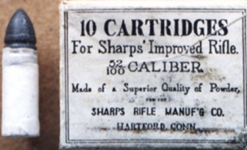
The church business wasn’t cut-and-dried, all black or all white, however. Many soldiers carried pocket Bibles to the battlefield, but about as popular were decks of playing cards. Fire and brimstone church folk might have said they carried Jesus in one pocket and the Devil in the other. Close to home, Newport’s Baptist Preacher Adams asked “in a red hot prayer that ‘all Rebels be sent to Hell,’” an uncharitable request for a man aspiring to love his neighbor but an understandable one. [24] Henry Ward Beecher, the pastor of a Congregational Church in Brooklyn, also mirrored America’s moral confusion as the country drew closer to the abyss. He sent “bibles” to abolitionists in Bleeding Kansas where guerilla war over slavery was ongoing. These bibles, however, were Sharps rifles—the same rifle Amos would use in 1862 as a U.S. Sharpshooter—and you didn’t want to be in the sights when a preacher took aim with a Beecher bible. Apparently, Henry had no problem with breaking the sixth commandment, “thou shalt not kill.” Henry was Harriet Beecher Stowe’s brother and also a man of contradictions. He sent the rifles to Kansas but praised God’s love in his sermons. He may have practiced what he preached too well because in 1875 a rumor circulated involving him and hanky-panky with a friend’s wife. If the gossip was true, Henry did with the seventh commandment what he did with the sixth—broke it.
One could hardly blame Amos, then, if his feelings about church were mixed, but he may still have asked himself what God wanted him to do. A lot of the people around him were making speeches, saying prayers, and calling on the Lord to help the Union. His brother Ben’s family were Methodists. If Amos’ parents were, it’s likely he attended services as a boy. Whether he was a churchgoer or wasn’t, he was surrounded by people who owned, read, and believed in the Bible. No doubt, many of them provided him with more grist for the mill as he meditated on soldiering.
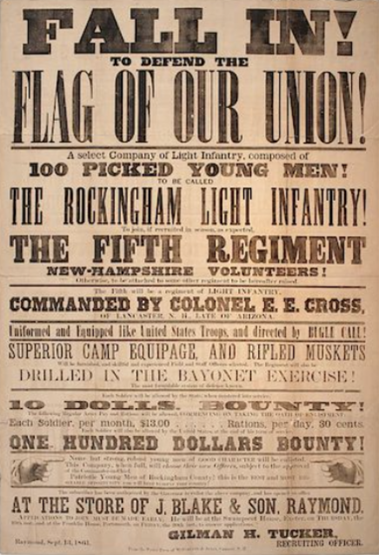
More young men from Grantham, Croydon, and Newport enlisted during the summer of ’61, and in August another member of the Hastings family followed Jon and Noah Merrill’s lead. Frank Taylor and Elvira had been wed for two years. When he enlisted in August, she was eighteen, and he had turned twenty-five on America’s birthday. Justice of the Peace Isaac Reed handed Frank the papers, and Frank signed. With a stroke of the pen, he belonged to the Union Army for the next three years. His outfit, Colonel Edward Cross’ Fifth New Hampshire Infantry, would become one of the most renowned regiments of the War. It would also lose more men than any other Union regiment. Almost a third died during the war, and almost half were discharged because of wounds or illness. [25] Frank was one of the lucky ones who survived without a major wound. He must have thanked his lucky stars. In October of ’64, he mustered out at the end of his three-year hitch, one of a hundred-odd men still left in a regiment that had started the war a thousand strong. When he returned to Newport to see his in-laws, Ben and Eliza, the reunion must have been hard for all. Frank’s wife—Ben and Eliza’s daughter—Elvira, had died in ’62. If Frank had been granted a furlough, he would have seen them at Elvira’s funeral. Her death, at twenty, must have been heartbreaking for all. She may have died from one of the many illnesses of the time, of childbirth, or by accident. Who knows? Oddly, her vital record doesn’t give the cause or date of her death. Her passing remains a mystery.
Playing the Hand
And then came Amos’ turn. After speeches on the Newport Common that summer, sermons from the pulpits, the sight of local men in uniform, talks with his family, and maybe many talks with Nancy, Amos threw his hat in the ring. He and some other men met with John Moores, the recruiter, who made a pitch for the Second United States Sharpshooters. They were told Berdan’s Sharpshooters offered better pay and were a new, “elite” regiment. [26] There was only one catch. You had to prove yourself. Amos did so. After putting ten shots in a ten-inch circle at two hundred yards, his enlistment in Company G was accepted. Not everyone would later call the Sharpshooters—the first U.S. Army snipers—men of good character, but one thing was sure: they knew their job. Colonel William Fox, a veteran of a New York infantry regiment said:
“Berdan’s United States Sharpshooters were the best known of any regiments in the army… They were of a high grade in physical qualifications and intelligence. They were continually in high demand as skirmishers on account of their wonderful proficiency as such, and they undoubtedly killed more men than any other regiment in the army. In skirmishing they had no equal.” [27]
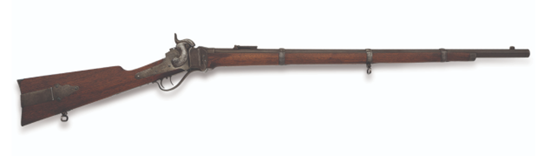
The U.S. Sharpshooters were finally issued the much-prized Sharps rifle in May and June, 1862
I mentioned my wife’s surprise that a thirty-three-year-old man with a wife and four children would volunteer to serve in the army. I’ll never be completely sure why he enlisted, but I’m pretty sure it wasn’t for the bounties (i.e. bonuses). He would have earned much the same making scythe blades. I also doubt it was for the adventure or the glory. He was no longer a callow youth. He was old enough to know better. He heard a great clamor for war that summer, and the parades and speeches may have caught his attention, but I wonder if a more powerful reason took hold of him.
Like many of his fellows, Amos had a grandfather who fought in the American Revolution. In fact, he had two. The man for whom he was named, Amos of Bethel, answered the Lexington alarm, fought at Bunker Hill, and served at the Battle of Saratoga. His mother’s dad, Ben Baker, was with John Stark’s men at Bunker Hill. Why did they fight? For freedom? For many, the burning desire for freedom was kindled by Thomas Paine in “Common Sense.” A year later, the Continental Congress coaxed that flame into life when they declared a free America on July 4, 1776. Did Amos of Grantham also think of his in-laws, the Manchesters, who were helping slaves board the “freedom train?” Did he think of the Lovejoys fighting for freedom in Kansas, freedom for everyone? Less than a hundred years after the Revolution, did Amos fight for a will-o’-the-wisp, the idea of freedom? Or—like many soldiers from the North—was he only fighting to save the Union. I like to think he followed in his grandfather’s footsteps, that he believed all people should be free. Short of finding a yellowed letter in his hand, my guess is that Amos went to war for one of these last two reasons. In either case, go he did, and it cost him dearly.
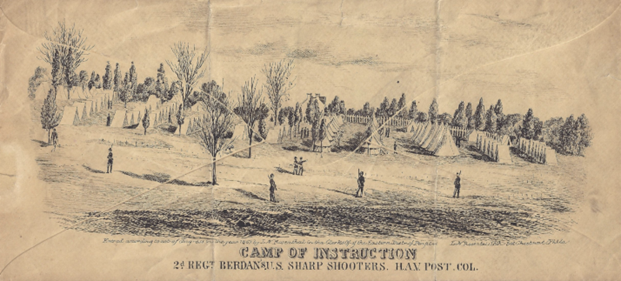
Rosenthal Brothers’ lithograph of Camp Instruction. Sold to soldiers as stationery
Amos enlisted on October 11, 1861. In December, he mustered in at Camp Hale in Concord and boarded a train to Washington, D.C. The First and Second Sharpshooter regiments drilled through the winter at Camp Instruction about a mile and a half from the Capitol. They could see the dome from their tents. They honed their shooting skills, learned skirmishing tactics and fighting in four-man cells, and practiced line-of-battle formations and maneuvers. It’s possible that Amos came down with a camp fever during the early months of ’62. Many did, and if he was one of them, he was lucky to survive it. Private George Marden wrote about the “death parade” that occurred in January and February at the camp:
“There is a funeral or perhaps two every day and the Regimental Ambulance if there is one dead and followed by a covered Sutter’s [sic] wagon if there are two, these preceded by the Buglers playing a Dirge… this procession has become so common that it excites hardly a remark more than, ‘There goes another poor fellow in a box,’ or ‘we are all going.’”
The Sharpshooters trained for the battlefield until late March of ’62 and then moved to the Virginia Peninsula for a spring and summer campaign. The Second U.S. Sharpshooters suffered heavy losses during Pope’s Campaign in August. The action started after leaving Falmouth with six or seven hundred men in the ranks on August 10th. Amos fought at Groveton during the Second Battle of Bull Run as did Jonathan and Noah Merrill with the Second New Hampshire. Frank Taylor was also there with the Fighting Fifth, covering the retreat. After Bull Run, only one hundred twenty-seven men stood at attention for roll call at Alexandria on September 2nd.
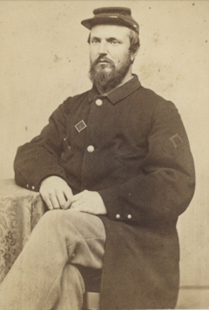
Corporal Abner Colby, Company G, 2nd NH U.S.S.S.
Then came Antietam, the single, bloodiest day of battle in American history. Noah Merrill died of his wounds the day before the battle. Just after dawn on September 17, 1862, Colonel Henry Post led the Second U.S. Sharpshooters south toward the Cornfield. He, along with a quarter of his regiment, would be wounded that day and sent to the rear. Amos was with the New Hampshire men of Company G. Their commander, Captain William Macpherson, whose wife Elizabeth died just before the war started in ’61, would be badly wounded and leave the army by November 1st. He would die five years later in New Orleans and be buried beside Elizabeth in the Old North Cemetery in Concord. First Lieutenant John Moores, who recruited Amos in Newport, was forty-nine when he enlisted. I suspect the younger men called him “Granddad.” He was probably wounded, too, because he would resign two weeks after MacPherson and die just four years later in Marshalltown, Iowa. First Lieutenant John Thompson, a young machinist from Nashua, would also meet his maker that day. Corporal Abner Colby’s luck would take a turn for the worse but not until the Battle of the Wilderness in May of ’64. He would be imprisoned in Andersonville like Amos’ nephew, Henry Sawyer [28]; Private Christopher Columbus Blake would suffer an ugly head wound from a lead ball bouncing off his skull. After two days in a field hospital, he would walk twenty miles to Frederick, Maryland in search of a doctor able to treat a brain injury. Privates William Sischo of Goshen and Fred Burge were with the company. Sischo would write a letter to the Bureau of Pensions on Amos’ behalf in 1877, and Burge would do the same in ’89.
Nearby were two privates in Company F, Wyman White and Joseph Everest. White’s Civil War Diaries would one day give readers a “boots-on-the-ground” view of the Sharpshooters’ war. If the men called John Moores Granddad, they must have called Joe “Great Granddad.” He was Amos’ neighbor from Plainfield on the other side of Croydon Mountain. He claimed to be forty-four when he enlisted but was really fifty-five. Before the morning was over, he would be shot in the thigh. The reaper took him a month later.
But that was all still to come. For now, the men marched southward across wet ground. It had rained during the night, and rags of mist grayed the landscape. Far to the north, Nancy was either with her dad in Island Pond, Vermont or had returned home to New Hampshire. Her mother had died four days earlier, and Nancy had attended her funeral. On the morning of the seventeenth, Amos knew nothing of Nancy’s troubles. He had plenty of his own. At about 6:30, the Second U.S. Sharpshooters and the regiments of General John Gibbon’s famous “Iron Brigade” moved into the western Cornfield near the Dunker Church. It was the same John Gibbon whose scout would visit Pompey’s Pillar when another Civil War veteran named Custer made his last stand at the Little Bighorn River. Born in 1827, Gibbon was a year older than Amos.
Dunker Church and Confederate dead. Photo: Alexander Gardiner
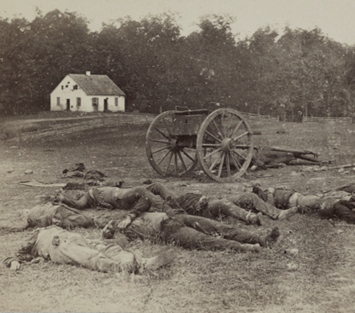
While Amos was working at the scythe factory in ’59, John was writing “The Artillerist’s Manual” for the U.S. Army. Amos and the Sharpshooters fought alongside Gibbon’s troops with Major Rufus Dawes commanding the Iron Brigade’s Sixth Wisconsin Infantry just to the Sharpshooters’ right. [29] As they neared the rail fence separating the Cornfield from a pasture to the south, a regiment of Georgians waited in the grass. Dawes wrote:
“… a long line of men in butternut and gray rose up from the ground. Simultaneously the hostile battle lines opened a tremendous fire upon each other. Men were knocked out of the ranks by dozens. But we jumped over the fence, and pushed on, loading, firing, and shouting as we advanced. There was… a great hysterical excitement, eagerness to go forward, and a reckless disregard of life, of everything but victory.”
They pushed on toward the high ground across from the church, but two Confederate brigades under General William Starke rushed toward them from the woods west of the turnpike and fired on their flank. Dawes ordered the Sixth and the Sharpshooters to wheel and face them. From the West Woods, two more regiments of the Iron Brigade came to their aid and fired on the flank and rear of the Confederates. The Rebels fell back and Dawes and his Union troops came within two-hundred yards of reaching their goal—the high ground across the road from the bullet-riddled church. Then, John Bell Hood’s two-thousand man Texas Brigade streamed out of the woods. Dawes said their first volley “was like a scythe running through our lines. The Sixth Wisconsin and Second Sharpshooters… were taken by surprise. Some stopped and fired as they retreated. But most raced headlong, tripping and stumbling over the bodies of men in blue and gray who already had died vying for possession of that ravaged 20-acre field.”
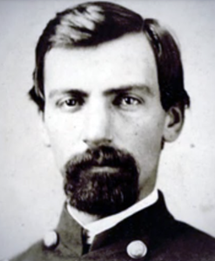
Major Rufus Dawes, 1839-1899. His son Charles would become Vice President under Coolidge and win the Nobel Peace Prize.
In that retreat, Amos Hastings leaped over a rail fence and landed in a heap at the bottom of a deep ditch. He described the event in his application for a pension:
“… I jumped over a fence and down an embankment, spraining my back and legs so badly that for a time I could not help myself. I kept with my company, wholly unable to do any duty, and being treated by William B. Reynolds, then Assistant Surgeon of my regiment, until about February, 1863… when I was sent to a general hospital at Aquia Creek, [Virginia] where I remained from six to ten days, and from there was sent to Convalescent Camp, near Alexandria, Va. having medical treatment occasionally, until discharged from the service.”
Assistant Surgeon, William Reynolds
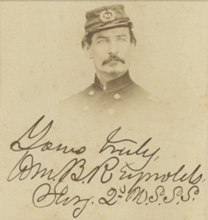
William Sischo confirmed Amos’ description of his accident. He said the embankment was eight to ten feet high and Amos was unable to move without assistance. How long did Amos lie in that ditch, listening to the screams and moans of other men, wondering about his own injury and if he would ever walk again? Did Sischo and another Sharpshooter help him off the field? Someone did, but maybe not until late in the day or even the following day.
Amos remained with the Sharpshooters at Antietam through October and then moved down the Potomac River when his regiment joined General Burnside’s attack on Fredericksburg in December. Amos must have stayed in camp during any action. After being defeated once, Burnside tried to cross the Rappahannock River again in January so the North could take Richmond. This action was known as the Mud March because heavy rain turned the countryside into one great quagmire. It’s hard to imagine how Amos managed. The surgeon, William Reynolds, may have hoped Amos would eventually be fit for light duty. It was not to be. Before the Sharpshooters tried to cross the Rappahannock again, Company G left him in the care of the tiny Aquia Creek Sanitary Commission Hospital. He was transferred within a week or so to Camp Convalescent across the Potomac from Washington in Alexandria, Virginia. When she visited in October soon after Antietam, Clara Barton called it “a sort of pen into which all who could limp, all deserters and stragglers, were driven promiscuously.” [30] Amos was no deserter, but he was a straggler. He could barely walk. The soldiers named the place “Camp Misery” early on, but conditions improved after February, ’63 when wooden barracks were completed and the supply of food and other necessities became more reliable.
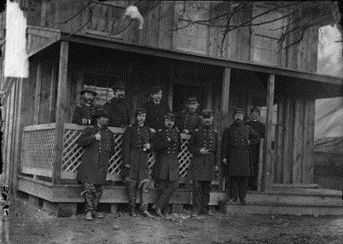
Union troops at field hospital, Aquia Creek, VA
Probably Amos wrote to Nancy about his injury and his “convalescence.” Did she send him food? Perhaps. Did she visit him there? Thinking of the four young children in her charge and a pricey train ticket to boot, I imagine not. Seven days after his father died on September 15, 1863, Amos was honorably discharged from his regiment. If he was treated like most disabled soldiers, he boarded a troop train going to Bradford, New Hampshire and was met by a family member at the station, perhaps his brother Ben. Since funeral services were performed within a day or two after a death, he was too late to attend his father’s funeral. [31]
I don’t know whether Amos wanted to abolish slavery, but I do know he fought in a battle that turned the tide in that direction. In spite of General McClellan’s plodding, pedestrian handling of his Union troops, he didn’t lose, and in spite of General Lee’s daring, “hit ‘em first” tactics, he didn’t win. Antietam was nobody’s victory, nobody’s but Lincoln’s. The President snatched a political victory out of the jaws of a military draw. It was a supremely historic moment. Five days after the battle, he declared the slaves in the Confederacy to be free, said they would be physically free at the moment of Union victory. He hadn’t dared do this before. The North had blockaded southern ports, and France and England were growing antsy over the loss of the South’s cotton for their mills. Before Antietam, they were considering whether to rescue the South. Lincoln, meanwhile, risked losing the slave states that had so far remained in the Union—Maryland, Delaware, Kentucky, and Missouri—if he declared universal emancipation. If he lost those states, and England and France intervened, the Union would be in big trouble. Lee’s performance in Maryland, however, was not strong enough to encourage help from Europe, and Lincoln felt safe in taking a first step to end slavery. Complete emancipation would only come with the thirteenth amendment at the end of the war, but after Antietam, the writing was on the wall. The white man’s boot was coming off the black man’s neck.
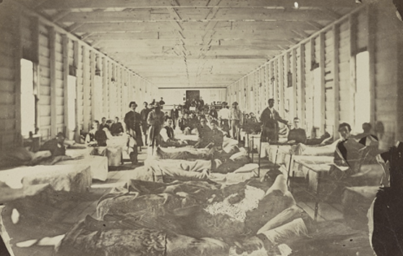
Wooden barracks replaced tents by the time Amos entered Camp Convalescent in February 1863
There were other people whose presence at Antietam made me think that the battlefield was a nexus, a place where people, ordinary and extraordinary, would wrestle in a titanic struggle with America’s demons and with the “better angels of our nature” Lincoln spoke of a year later at Gettysburg. If anyone was welcome by those who suffered at Antietam, it was Clara Barton. She risked her life bringing aid to wounded soldiers and was known amongst the troops as the “Angel of the Battlefield.” Twenty years later, this brave woman would found the Red Cross. She arrived at Antietam’s Cornfield by noon with a wagonload of medical supplies. Amos may have been lying helpless and untended nearby. Soon, she was handing bandages to surgeons who were dressing wounds with corn husks. Tending to a soldier herself, she had a close call:
“A ball… passed between my body and the right arm which supported him, cutting through his chest from shoulder to shoulder. There was no more to be done for him and I left him to his rest. I have never mended that hole in my sleeve. I wonder if a soldier ever does mend a bullet hole in his coat?” —Clara Barton [32]
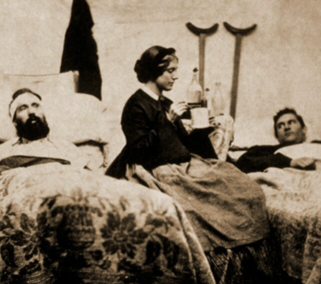
Clara Barton, 1821-1912, “Angel of the Battlefield”
Robert Gould Shaw was another notable figure at Antietam. Like many, he had wrestled with his conscience over slavery. His parents were members of the American Anti-Slavery Society, but he was reluctant to embrace their politics. Then, he read Uncle Tom’s Cabin and changed his mind. Slavery, he realized, was wrong and no acrobatic arguments could make it right. He enlisted with the Second Massachusetts Infantry and trained at Camp Andrew, once the site of Brook Farm where Boston’s transcendentalists started a utopian experiment next door to the Shaw family’s former home. [33] Robert’s regiment entered the Cornfield a few hours after Amos, but luckily for the Second Massachusetts, they didn’t suffer high casualties. After Antietam, Shaw commanded the Fifty-fourth Massachusetts Infantry, the first regiment of black troops in the U.S. Army. The Fifty-fourth attacked heavily-defended Fort Wagner in South Carolina in ‘63. Shaw died at the head of his troops during the assault, and the regiment lost almost half its soldiers, but their courage inspired other black men to enlist by the thousands. Confederate General Johnson Hagood buried Shaw in a mass grave with the black troops as a sign of disrespect, but Shaw’s parents approved, saying Robert would have wanted to be with his men.
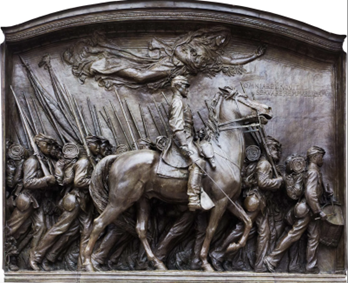
Colonel Robert Gould Shaw and the 54th Massachusetts Infantry marching down Beacon Street, May 28, 1863. Memorial located on Boston Common, facing State House. Sculpted by Augustus Saint-Gaudens.
Captain Oliver Wendell Holmes, Jr. of the Twentieth Massachusetts Infantry was another Boston man. As a boy he had discussed Plato with Ralph W. Emerson and abolition with the militant Reverend Theodore Parker. Immediately after the war he joined the Alpine Club in Europe and scaled a twelve thousand-foot Swiss peak called the Balmhorn. [34] On his return to the United States, he began his study of the law. He would, one day, become a Justice of the U.S. Supreme Court. During his experience at Antietam, he was shot twice when his regiment was ordered to make an ill-advised advance into the West Woods. One bullet broke the buckle on his knapsack, and the other passed through his neck. A field surgeon examined him and said, “I have no time to waste on dead men.” Fortunately, one of Oliver’s comrades insisted he be taken to a nearby home where he was given first aid. Oliver’s father, Oliver Holmes, Sr., was a well-known doctor and one of the “fireside poets” along with Longfellow, Whittier, Bryant, and Lowell. Late on the day of the battle, he received a telegram with the news of his son’s wound. He boarded a train the next morning and found Oliver about to leave Hagerstown, Maryland that afternoon. What relief father and son must have felt! In “My Hunt After the Captain,” an essay for The Atlantic, Oliver Holmes, Sr. described sights similar to those Amos would have seen in the aftermath of Antietam:
“The slain of higher condition, “embalmed” and iron-cased, were sliding off on the railways to their far homes; the dead of the rank and file were being gathered up and committed hastily to the earth; the gravely wounded were cared for hard by the scene of conflict… while those who could walk were meeting us… at every step in the road. It was a pitiable sight.…” [35]
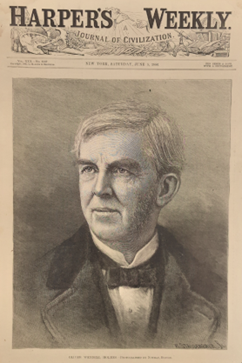
The day after Antietam, Oliver Wendell Holmes, Sr., 1809-1894, traveled to Maryland to find his wounded son.
The American artist Winslow Homer was born in Boston, but he was living in New York City when Harper’s Weekly magazine sent him on assignment to Antietam. As an artist and reporter for Harper’s, he had begun a painting of a U.S. Sharpshooter at the Union siege of Yorktown that spring. [36] An engraving made from the painting ran in Harper’s November issue right after Antietam, apparently because the public was fascinated by this new kind of soldier. Homer himself was a changed man after spending time with the Sharpshooters at Yorktown. His mother wrote that for two or more months he was “without food 3 days at a time & all in camp either died or were carried away with typhoid fever….” [37] He struggled with what was happening around him, the horror, deprivation, and ugliness of war, the dilemmas of right and wrong.
His encounter with Berdan’s U.S. Sharpshooters confronted him with one of these dilemmas. These soldiers were seen as “elite” troops by some, but at the front they were often “reviled as ‘murderers’ by both sides, [and] sharpshooters usually were executed if captured.” Homer wrote the following to a friend after looking through the telescopic sight of a sharpshooter’s rifle: “The . . . impression struck me as being as near murder as anything I ever think of in connection with the army & I always had a horror of that branch of the service.” [38] I wonder what Amos thought, when he put a Rebel in his sights. Maybe he refused his feelings in the moment and concentrated on aim and trigger pull. But maybe he, too, had times when he felt a horror of his handiwork. Putting a bullet in a ten-inch target at two hundred yards is a different thing than shooting an unsuspecting man from hiding. But then again, in this first modern war, where so much killing was done with such deadly ease, with the armys’ new rifles, rifled cannon, Minié balls, canister shot, case shot, and other murderous inventions, there must have been more than enough horror to go around.
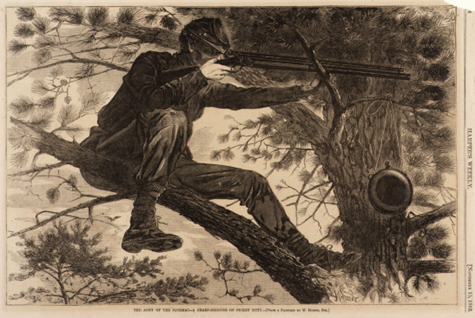
Winslow Homer camped with the U.S. Sharpshooters at Falmouth, VA in the spring of 1862 and was at Antietam on September 17th.
Two days after Antietam, Alexander Gardner arrived at the battlefield to document… what? He must have been shocked. Probably, he didn’t understand himself what he was about to do. He soon learned. He stood amidst thousands of bodies turning black, beginning to smell, still being buried. He was there to document the horror of war.
Gardiner was born in Scotland and emigrated to the United States in 1856. He had never intended to be a photographer. Inspired by the socialist Robert Owens, he and others bought land in Iowa to build a co-operative community in 1850. Returning to Great Britain in ‘51, however, he chanced to see Matthew Brady’s photography exhibition at the Crystal Palace in London. That was it. He became a shutterbug.
Alexander Gardiner’s startling photographs showed the public the horror of modern warfare for the first time.
His photographs from Antietam rocked the public imagination. He took pictures of corpses lying helter skelter along the turnpike, in the Cornfield, in Bloody Lane, everywhere on the battlefield. His employer, Matthew Brady, displayed the photos at his New York City studio. A hundred years later, television reporters and cameramen brought the stark reality of war into American livingrooms in a new way during the Vietnam War. Alex Gardner, taking the first photos of the dead on an American battlefield, accomplished the nineteenth century equivalent with the images from Antietam. A New York Times writer said:
“Mr. Brady [whom the Times credited with Gardner’s work] has done something to bring home to us the terrible reality and earnestness of war. If he has not brought bodies and laid them in our door-yards and along streets, he has done something very like it.” [39]
Amos was there—in the middle of it all. He didn’t need photographs to see the carnage. At times, he must have wished he could erase the ghastly pictures that paraded through his mind, asleep or awake.
Amos’ homecoming, like Frank Taylor’s, must have been bittersweet. In his letter to the Bureau of Pensions, he said he lived in Newport for two years after his return from Antietam. He could have taken the stage when he got off the train in Bradford, but I think a member of his family probably picked him up at the depot. I can imagine his arrival in Northville. Nancy met him on the doorstep of their home and watched him climb down with difficulty from the wagon and shuffle toward the house, gaunt and weary, but perhaps with a light in his eyes that had long been dimmed.
On October 7, 1863, Shepherd Bowers, Probate Judge of the Sullivan County Court, attested to Amos’ honorable discharge and the disabling injury he received at Antietam. [40] Amos was thirty-five when the army sent him home. He left for the war an able man, a blacksmith, husband, and father of four. He came back a shadow, a man unable to do anything in the way of work for half a year after his return. It’s not clear when Amos first received a veteran’s disability check. The Bureau of Pensions rejected his invalid’s application in 1877 because the army could find no record listing him as a casualty or describing his injury. He applied again in ’84 with affidavits from Fred Burge, his tentmate, and William Sischo. Both men, like Amos, were soldiers in Company G. Burge testified to hearing Amos describe a “hart out of kilter” after their outfit camped in the malarial swamps of the Virginia Peninsula during the spring of ’62. Camp fevers were rampant during the war, and Amos might easily have caught one, maybe even rheumatic fever which can cause a racing or fluttering heart. Sischo verified that, leaping over a fence while in retreat at Antietam, Amos had injured himself so badly he couldn’t move afterward without help.
The Bureau of Pensions didn’t accept Amos’ 1884 application either. As late as ’89, Bureau correspondence requested corroboration of Amos’ disability claims from the War Department. At some point, maybe not until after ’89, the government sent Amos his first disability check. We know he did finally get a pension because a letter from the Pension Office in Concord—stamped “received,” March 19, 1895—notified the Commissioner of Amos’ death on July 19, 1894 and the last payment of seventeen dollars sent to him on July 4, 1894. Another foray into the National Archives might shed more light on Amos’ ups and downs with the Bureau of Pensions, but until then, we can say with confidence that Amos’ monthly check from Uncle Sam did not appear like the genie from the lamp to rescue him from money troubles. To be fair, Uncle Sam had to be wary of con men because the payout to veterans was becoming an eight hundred pound gorilla. “By 1863 more than a million men were on the pension rolls, and pensions consisted of more than 40% of the federal government’s expenses.” [41] Nevertheless, men like Amos were a reminder that the price of war is not only counted in dollars and cents. One Sharpshooter expressed it this way:
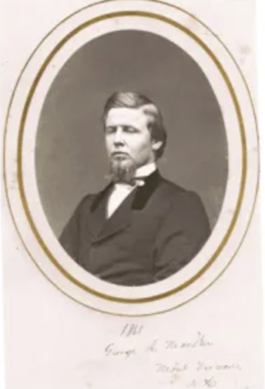
George Marden, 2nd U.S.S.S. wrote letters home.
“I don’t think we shall ever be aware of the great changes this war will effect in us and our plans. … there will be crooked, rheumatic living monuments creeping home just enough to show that the war is still at work.” — George Marden, 2nd U.S.S.S.
For the next thirty-one years, Amos and Nancy would wander up and down the Connecticut River, looking for work Amos could do in Upper Valley towns. They lived in Bellows Falls, and in Ely, Vermont, and in Lebanon, Enfield, Claremont, and Hanover. They also lived in the northern towns of Haverhill, Littleton, and Bethlehem, New Hampshire where Nancy’s Sawyer relatives were nearby. Sometimes they stayed a year in one place, sometimes two or three years. Their daughter, Cora Minnie, was born in Enfield in April, 1865, so Nancy and Amos probably visited Maria and Tim Manchester there for Nancy’s “lying in.” Nancy may have visited her sister’s family during Amos’ army service as well. When her mother died, days before Amos was injured in the Cornfield, being with Maria might have been a comfort. According to her obituary, Maria “was a member of no church, but she lived her creed showing in her daily life her love and devotion to her family and friends.” No doubt, Nancy missed her sister when the Manchesters moved to Kansas in ’77.
Decoration Day Comes and Goes
When lilacs last in the dooryard bloom’d
And the great star early droop’d in the western sky in the night,
I mourn’d, and yet shall mourn with ever-returning spring.
—Walt Whitman
Edgar and Cora Minnie (Hastings) Lovejoy (middle, first row) and their family.
Pulling up stakes every year or so must have made it hard for Amos and Nancy’s kids to make any lasting friends, hard on their education, too. Cora Minnie, born at the very end of the war, only completed third grade. Amos worked as a teamster when he could. He could do other light work, but it had to be light. In his own letter to the Bureau of Pensions, he said:
For more than six months immediately following my discharge, I could not do anything, and since then, I have not been able to do a quarter of a well man’s work…. I cannot carry a ten-quart [twenty pound] pailful of water more than forty feet without feeling faint and being obliged to sit down.
He and Nancy carried on as husband and wife. After Amos returned, they had six more children, ten in all. Eventually, they settled in Claremont with some of their children nearby. Nancy died in 1884. The cause was apoplexy, commonly called a stroke today. She was fifty-three, and I wonder if exhaustion played a part in her early death. Her daughter-in-law, Mary Addie, would die four years later in childbirth, and John Amos would send his three oldest children to other families to begin their working lives. Ophelia Mae, the youngest of the three, was only nine. She would live to be one hundred five.
Nancy’s older brother Isaac Sawyer may have been living nearby during his sister’s last years in Claremont. He and his wife Susan lived in Lebanon in 1880 with their son Henry and his wife. Henry had enlisted at nineteen in 1862. He and 237 members of the 11th Vermont Infantry were captured at the Battle of Weldon Railroad on June 23rd, 1864 and sent to Andersonville Prison in Georgia. Twenty-year-old Robert Kellog described what he saw when he passed through the prison gates:
“As we entered the place, a spectacle met our eyes that almost froze our blood with horror…before us were forms that had once been active and erect—stalwart men, now nothing but mere walking skeletons, covered with filth and vermin…Many of our men exclaimed with earnestness, ‘Can this be hell?’” [42]
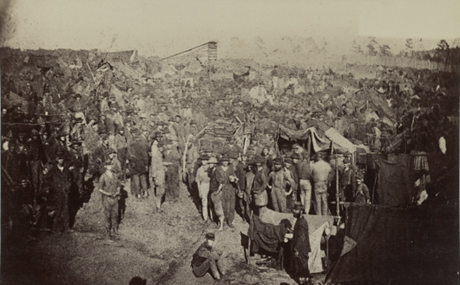
Prisoners await rations at Andersonville. Of the 45,000 prisoners there, 13,000 died in custody.
Henry arrived soon after a prison riot between the Raiders and the Regulators. The Raiders stole from and sometimes murdered other prisoners. Those prisoners formed the Regulators to defend themselves. On July 11th, six of the Raiders’ leaders were hanged. After five months, Henry was paroled just before Christmas. He came out looking worse than a scarecrow, ill, and remembering things he wanted to forget. He was lucky to be alive, but his health would never fully return. Isaac and Susan, with Henry and his second wife, moved to Claremont some time after 1880, so Nancy may have renewed her relationship with her brother before she died.
Amos passed away in July, 1894, probably at Claremont’s new Cottage Hospital. He was sixty-six. The cause of death was peritonitis, an infection of the lining of the abdomen. Perhaps some of his children were there to comfort the old soldier at the end.
Claremont’s Cottage Hospital established in 1892
Amos’ nephew, Jonathan Merrill, was severely wounded in the “Peach Orchard” at Gettysburg on July 2, 1863. Martin Haynes, also in Company I, was with him and mentioned the incident in his memoir, A Minor War History:
“Gettysburg, Pa., July 4, 1863 … the Second Regiment was in the very fiercest of the fight and met its heaviest loss yet in any one battle. About two hundred are gone out of our little regiment, but, as usual, I came through all right. I don’t know now how I did it. While we lay supporting a battery, before we had fired a shot, one shell burst right in my group. The man who touched me on the right [Jonathan Merrill] had his thigh cut away, and the two at my left [Lyndon B. Woods and Sergeant James M. House] were very severely wounded—and I never had a scratch. Talk about luck!” [43]
After weeks in a field hospital and months in a Baltimore hospital, Jon was mustered out a year later and returned to Mary Minerva Hastings at the ripe old age of twenty-three. They lived in Grantham—presumably on the parcel of land deeded to Mary by her father Samuel—and had four children together. He farmed and worked as a carpenter. Mary died in January, 1879 of “nervous prostration.” She was thirty-five. Jon married Elizabeth Messer in September, and they lived out their years in nearby Newbury where Jonathan died at eighty-five.
Soldiers Home, Togus, Maine, 1906
Frank Taylor served in the Fighting Fifth until the very end of the war. He was a sergeant when he was discharged two months after the South surrendered. Then, he disappeared for thirty-five years. In 1900, he surfaced in Maine as a resident and waiter at the Eastern Branch Soldiers Home in Chelsea, next door to the state capital of Augusta. Investigations of this, and other national soldiers’ homes, resulted in “charges of abuse, immorality, and corruption.” Congress responded to the investigations in 1884, saying that the institutions should be:
“homes for the country’s defenders, not asylums for the helpless poor.” Yet the report also found a depressing atmosphere of gloom. The managers of the National Home had to “deal with cripples, rheumatics, epileptics, dyspeptics, men who have been victims of excessive drink, depressed by a sense of advancing age and penury, men of all degrees of mental and moral development, who have no future to look to beyond the grave-yard in sight of the home….” All the National Homes were surrounded by places to buy alcohol, eager to take veterans’ pensions and earnings. Many veterans were willing customers. Some certainly became alcoholics. How much problem drinking was a direct result of trauma during the war is difficult to gauge.… [44]
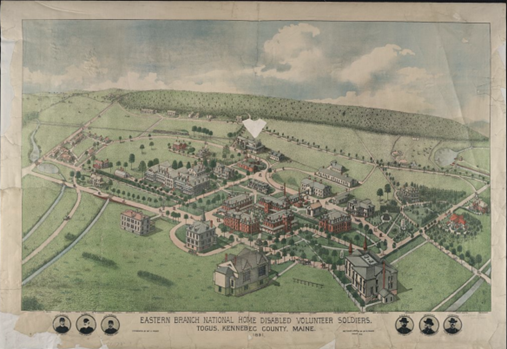
The Home for Disabled Soldiers, Togus (a.k.a. Chelsea), Maine. The grounds included a saloon.
A military record filed in 1907 said Frank was troubled with rheumatism and a bad heart valve. He was still at the Soldiers Home, still waiting on tables in 1910. He died at eighty in Boothbay, Maine on December 2, 1916, leaving behind no money or personal effects. A veteran of the Great Rebellion, he vanished like a footprint in the snow.
Did Amos ever return to Bethel, Maine to visit his Hastings relatives at the house on Broad Street? It’s possible. In the early 1870s, Amos and his family lived in Bethlehem, Haverhill, and Littleton, and in the Age of Railroads none of these towns was more than a day’s ride from Bethel. He and Nancy, or he alone, could have boarded a train and arrived in Bethel on the same day. Abigail lived at the Hastings Homestead until her death in 1874. In 1870, she was living there with her thiry-year-old son Daniel, his wife Eugenia, and their new baby girl, Mabel. Amos’ cousin Gideon, also a veteran of the War, was living next door with Dolly and their six children. It might have been a pleasant reunion, a chance for Amos to revisit some happy memories.
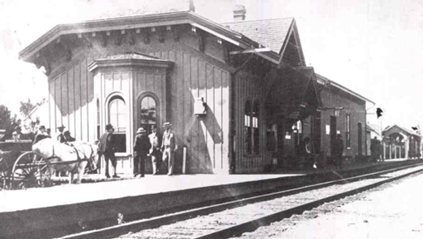
Railroad depot, Bethel, Maine, 1880. (Photo: Bethel Historical Society).
It’s just as likely, I suppose, that Amos never went back. He may have felt there was no going back. Twenty years earlier he had been young and healthy. Antietam had made him a doddering old man at thirty-five. His Uncle John had died in ’59. A lot of water had passed under the bridge. Would Aunt Abigail and Daniel welcome him? Would they think he came for a handout? And Gideon? He had served with the Twelfth Maine Infantry. Would they feel a kinship as veterans? Maybe, but Gideon had enlisted as a captain and come out a major. Amos had enlisted as a private, and come out a cripple.
If they talked about it, Amos and Nancy could have quickly convinced themselves a visit to Bethel would be an extravagance. They still had young children to feed and clothe in the 1870s, and with Amos’ disability, they had to count their pennies. Could they justify the cost of a railroad ticket just to visit family in Bethel, family Amos had not seen in twenty years?
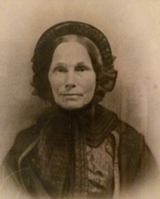
Abigail Straw Hastings, 1799-1874
Well—life is not always a matter of being sensible. What if Amos had fond recollections one day that put him in mind of the people who had once opened their home to him, memories of Aunt Abigail’s kindly way, Gideon’s guidance at the forge, and Daniel’s boyish laughter? He may, at least, have visited them in the halls of memory. Some good soul may have helped him up the steps of a rail car. I can see him, shuffling to a seat in the sun, riding the train to Bethel on a Monday near the end of May. Daniel pulls up to the depot with Abigail’s buggy. He and Gideon sit at the kitchen table with coffee and trade a story or two, not of the Rebellion but just of the South. Amos eases. Whatever his rank, he had served, and his was not easy duty. He fought in the Cornfield. What was it Dawes said? “Whoever stood in front of the Cornfield at Antietam needs no praise.”
When Gideon goes home, Amos goes to the front door facing Broad Street. Aunt Abigail stands under the elms and watches the sun glowing red on the crest of Pine Hill. As dusk falls, they go back to the kitchen. She asks about Nancy and his children. He asks if she is well, asks about Uncle John, his last years. He is younger than his aunt, but older than he should be. She understands him, he thinks. Without all the words, she still understands.
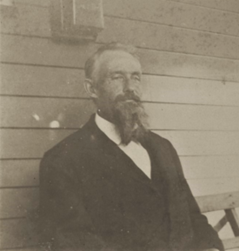
Daniel Straw Hastings, 1840-1925
Daniel and Eugenia return from their walk with little Mabel. Their talk at dinner, the soft laughter, Mabel’s bright excitement soothes him. Finally, he wants to retire. It is a great trouble for him to climb stairs, so Daniel makes up a cot in the room off the kitchen. After a time, Amos’ eyelids grow heavy. The window is open a hand-width for the air. A star shines in the blue-black sky. Leaves rustle outside. He drifts. Then—crack at the door. He starts, now fully awake. It is the cannons! The sky rips open, the screams of men rent the air. Then, a voice. “Rest well, cousin,” Daniel says softly. It was only his cousin’s footstep that he turned into a monster. The house settles. A breeze brings the scent of lilacs. Such a comfort. Now, tired, so tired, he will sleep… in peace.
NOTES
1 When I began this essay, I had not seen a reference to “Rebecca” Hastings in any record, so I was surprised to see “Affidavits of Death” recorded by both Abigail Hastings and Moses Mason Hastings which referred several times to Amos’ wife as “Rebecca” Hastings. The only explanation I can imagine is that this was her middle name, and the one used by her family, or that it was a nickname.
2 That Betsy Wiley Hastings moved in with her son John and daughter-in-law Abigail is only a guess. Probably several Hastings families would have invited her to live with them, but I think John and Abigail’s home would have been her choice. The fact that Betsy sought John’s help in applying for Amos’ pension suggests they were close. It seems likely, too, that she would have enjoyed being part of her son’s family in the big house on Broad Street and being part of life in the village.
3 Jonas was Amos and Betsy’s “lost son” for a time. He was not listed in at least one of the prominent Bethel, Maine genealogies, but the matter was settled when Randall Bennett discovered (circa 2023) Jonas’ name in the Hastings family Bible.
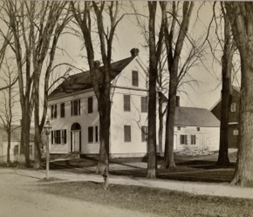
The Hastings Homestead with its stately elms.
4 Here is an excerpt from a road layout described in the Fisherfield (a.k.a. Newbury) selectmen’s minutes (circa 1780): “following Marked trees acrost Common Land to Jonas Hastings north line… [then] following Marked trees across Amos Hastings land by the west End of Said Hastings House bearing South East to Jonathan Merrill’s North line….”
5 He was probably named in honor of the future President who defeated Tecumseh’s warriors at the Battle of Tippecanoe in 1811. The following year, President Harrison defeated Tecumseh’s Native American confederacy and their British allies at the Battle of the Thames in Canada.
6 From the title of a collection of Norwegian fairy tales. East of the Sun, West of the Moon: Old Tales from the North.
7 Besides advocating slavery, Hammond violated his nieces. Secret and Sacred: The Diaries of James Henry Hammond, a Southern Slaveholder. James Henry Hammond. Pub: Carol Bleser, editor, Oxford University Press, New York, New York, 1988.
8 He later became a member of the African Methodist Church.
9 From Jimmy Driftwood’s 1936 song, “The Battle of New Orleans.” Driftwood was a singing high school principal in Arkansas who wrote songs to get students interested in history. Johnny Horton’s recording of the song hit number one on Billboard magazine’s “Hot 100” in 1959.
10 “Franklin Pierce, 14th President of the United States: 1853-1857, Inaugural Address.” Online: https://www.presidency.ucsb.edu/documents/inaugural-address-32
11 Many scholars agree that Lincoln did not greet Harriet this way. Many also agree that, if he didn’t say it, he should have.
12 “‘A Genuine Article,’ Harriet Beecher Stowe and John Andrew Jackson.” Susana Ashton. Commonplace: The Journal of Early American Life. Pub: Summer, 2013; issue 13.4. Online: https://commonplace.online/article/genuine-article/
13 Rose was born in December, and Apphia died in May, so Affie never met her granddaugher, but at least she met her son’s bride, Nancy, and knew her granddaughter was soon to join the family.
14 “Fugitive Slave Act, September 18, 1850.” American Battlefield Trust. Online: https://www.battlefields.org/learn/primary-sources/fugitive-slave-act
15 Pillsbury often joined Foster in interrupting Congregationalist services to question the church’s stance on slavery. He was also an early supporter of women’s rights. “Parker Pillsbury.” Pub: Freedom from Religion Foundation. Online: https://ffrf.org/ publications/day/parker-pillsbury/
16 Hill and Hollow: A History of Grantham, New Hampshire. Kenneth Story, editor. Pub: Grantham Historical Society, Grantham, New Hampshire, page 119.
17 I have found no evidence of Hastings abolitionists in Grantham. That doesn’t mean there were none. Many people of that time were careful about advertising their politics. Openly supporting abolition invited possible violence from pro-slavery people.
18 Ibid.
19 Original letter is at the Hastings Homestead Museum, Bethel, Maine.
20 Berdan’s United States Sharpshooters in the Army of Potomac, 1861-1865. Charles Augustus Stevens. Pub: The Price McGill Company, St. Paul, Minnesota, 1892, page 1.
21 Information on the Wakefields from: The History of Newport. Edmund Wheeler. Pub: The Republican Press Association, Concord, New Hampshire, 1879, pages 554-56.
22 History of Newport. Wheeler. page 94
23 “Proclamation 85: Proclaiming a Day of National Humiliation, Prayer, and Fasting.” President Abraham Lincoln. Pub: The American Presidency Project, University of California at Santa Barbara. Online: Gerhard Peters and John T. Woolley, The American Presidency Project https://www.presidency.ucsb.edu/node/202314
The veteran in a new field. Winslow Homer
24 Tales from the History of Newport. Sam H. Edes. Pub: The Argus Champion. Newport, New Hampshire. Online: https://shorturl.at/N2ExJ
25 “One Thing After Another.” The History Department Blog at Saint Anselm College. Pub: Saint Anselm’s College, Manchester, New Hampshire. Online: https:// shorturl.at/C5m52
26 “The U.S. Sharpshooters: Meet One of the Civil War’s Deadliest Regiments.” Jim Stempel. Military History Now. Pub: January 20, 2023. Online: https://shorturl.at/EFwgf
27 Regimental Losses in the American Civil War, 1861-1865. Colonel William F. Fox. Pub: Albany Publishing Company, Albany, New York, page 419.
28 Captured at the Battle of the Wilderness in May, 1864, Colby spent four months at Andersonville Prison in Georgia. When General Sherman took Atlanta in September, Colby was moved to a stockade at Florence, South Carolina and imprisoned for five more months. At the end of the war, the former private mustered out as a captain. In his application for an invalid’s pension thirteen years later, he told how his captivity ruined his health. From: 1. “Captain Abner Colby, Berdan’s Sharpshooters, POW, Archive Incl. USSS Medal, Ambrotype, Correspondence, & More.” Bid Square auction item, Lot 134. Online: https://shorturl.at/moJRv 2. “Civil War Prison Camps.” Gary Flavion. Pub: American Battlefield Trust. Online: https://www.battlefields.org/learn/ articles/civil-war-prison-camps
29 Rufus Dawes was the great grandson of William Dawes who, with Paul Revere, warned the Minutemen that the British were on their way to Lexington and Concord during the American Revolution. Amos Hastings, of Salem, New Hampshire and later, of Bethel, Maine, was one of those Minutemen. He answered the alarm in Captain Timothy Eaton’s company from Haverhill, Massachusetts.
30 “History of Camp Convalescent.” Pub: Alexandria City Hall, 301 King Street, Alexandria, VA 22314. Online: https://www.alexandriava.gov/historic-sites/camp-convalescent
31 Modern embalming was developed during the Civil War because soldiers’ corpses were being shipped home for burial, but it was not widespread until after the war.
32 “Clara Barton at Antietam.” Pub: National Park Service, April 10, 2015. Online: https://www.nps.gov/anti/learn/historyculture/clarabarton.htm
33 One of the founders of Brook Farm was Nathaniel Hawthorne, and visitors included Ralph Waldo Emerson, Margaret Fuller, and Bronson Alcott, some of Boston leading intellectuals.
34 Mt. Balmhorn had been climbed for the first time only two years earlier. “America’s Great Modern Justice.” Lincoln Caplan. Pub: Harvard Magazine, May-June, 2019. Online: https://www.harvardmagazine.com/2019/04/supreme-court-holmes
35 “Oliver Wendell Holmes, Sr., and the Aftermath of Antietam.” Jake Wynn. Pub: National Museum of Civil War Medicine, September 18, 2018. Online: https:// www.civilwarmed.org/holmes/
36 This was the same Yorktown where General George Washington defeated British General Cornwallis during the Revolution, 1781.
37 “Race, War, and Winslow Homer.” The New Yorker. Claudia Roth Pierpont. Pub: The New Yorker, April 11, 2022. Online: https://shorturl.at/x9d1j
38 “The Army of the Potomac—A Sharp-Shooter on Picket Duty.” Smithsonian American Art Museum. Online: https://shorturl.at/8FK1r
39 “Photography at Antietam.” Pub: National Park Service, September 15, 2023. Online: https://www.nps.gov/anti/learn/historyculture/photography.htm
40 A totally disabling injury to both knees had already been certified that same day by Doctors Mason Hatch and James Gregg.
41 “Coming Home: Civil War Pensions.” Battlefield Dispatch. Sarah Falck. Pub: Battle of Franklin Trust, Volume 3, Number 7, Summer 2019. Online: https://boft.org/ pensions
42 “Civil War Prison Camps.” Gary Flavion. Pub: American Battlefield Trust. Online: https://www.battlefields.org/learn/articles/civil-war-prison-camps
43 A Minor War History: A Soldier Boy’s Letters to “The Girl I Left Behind Me,”
1861-1864. Martin A. Haynes. Pub: “Private Print of Martin Haynes, Lakeport, New Hampshire, 1916. Online: https://shorturl.at/6GyxS
44 “Eastern Branch for the Asylum of Disabled Volunteer Soldiers—Togus, Maine.” Pub: Emerging America Collaborative Services, 97 Hawley Street, Northampton, Massachusetts. Online: https://shorturl.at/Fw9T2
